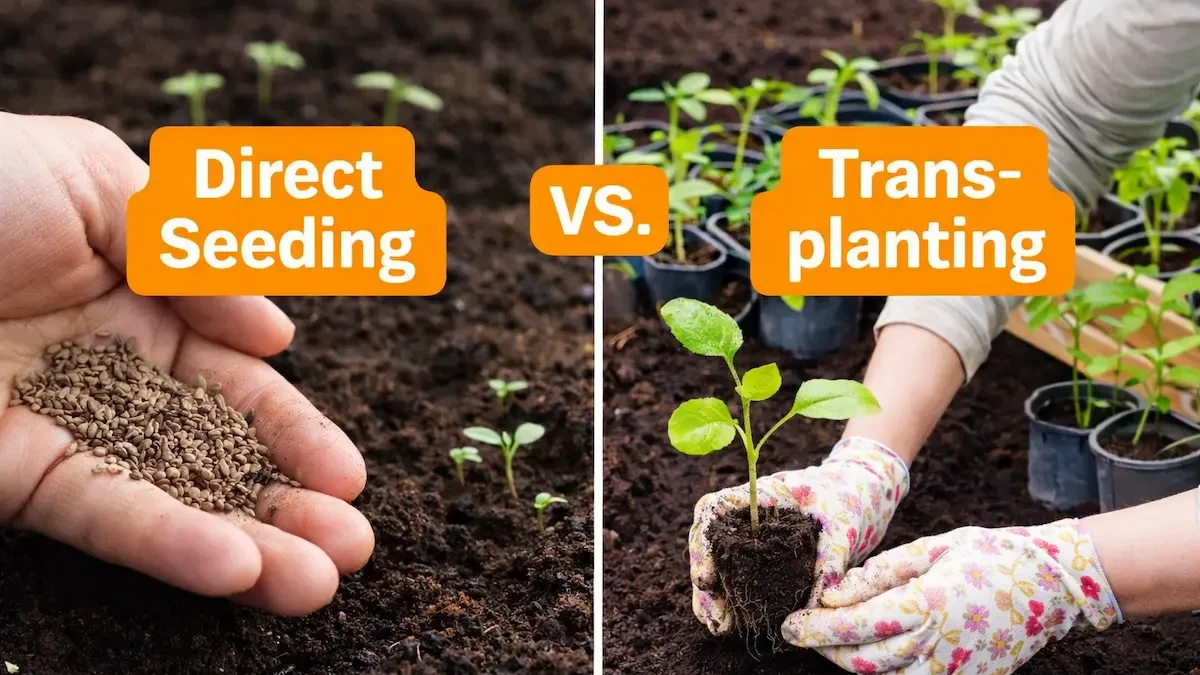
The decision isn’t about preference — it’s about plant biology. Root crops must be direct sown. Long-season crops must be transplanted in short-season climates. Getting this wrong costs you the harvest, not just a few weeks.
Quick Answer
Always direct sow: carrots, parsnips, beetroot, turnips, radishes, peas, spinach, beans. Transplanting root crops produces forked, deformed roots. Beans and peas suffer transplant shock that weakens them permanently.
Always transplant: tomatoes, peppers, aubergines, celeriac, celery. These need 6–12 weeks of warm indoor growth before the season is long enough to support them outdoors.
Either works: courgettes, cucumbers, kale, cabbage, lettuce, leeks, beetroot (carefully). The right choice depends on your season length and how much time you want to invest.
According to Cornell University’s Steve Reiners, the single most important factor in choosing between direct sowing and transplanting is not gardener preference — it is the biology of the specific crop. Crops grown for their roots simply cannot be transplanted successfully: when the taproot is disturbed during transplanting, the plant produces a fibrous root system instead of the single, straight root you’re growing it for. Carrots sold as transplant packs in garden centres are, in Reiners’ words, a mistake. The crop will fail regardless of how carefully the transplant is handled.
The Complete Reference: Which Method for Which Crop
| Crop | Method | Reason |
|---|---|---|
| Carrots, parsnips, turnips | Direct sow only | Taproot forms from germination — any root disturbance causes forking or failure |
| Radishes | Direct sow only | Fast-maturing; transplanting gains nothing and risks root damage |
| Peas, broad beans | Direct sow only | Both suffer significant transplant shock; weak and poor-yielding even when they survive |
| Spinach, arugula | Direct sow only | Quick-growing; doesn’t transplant well; direct sowing is simpler and equally reliable |
| French / runner beans | Direct sow only | Germinates readily in warm soil; transplanting causes shock with no timing benefit |
| Tomatoes, peppers, aubergines | Transplant only | Need 6–10 weeks of indoor growth; direct-sown plants won’t mature before autumn frost in most UK/US climates |
| Celeriac, celery | Transplant only | Tiny seeds need controlled germination; 10–12 weeks indoors required |
| Leeks | Transplant strongly preferred | Sown indoors in January/February; transplanted as pencil-thick seedlings for best results |
| Courgettes / summer squash | Either — transplant for speed | Direct sow works in warm soil; transplanting gives 2–3 week head start on harvest |
| Cucumbers | Either — transplant in short seasons | Germinates easily when soil is warm; transplant gives a head start in Zones 5–6 |
| Cabbage, kale, broccoli | Either | Both methods work; transplanting allows bed to be used for another crop until needed |
| Lettuce | Either | Highly adaptable; transplanting useful for precise spacing in small beds |
Why Season Length Is the Deciding Factor for “Either” Crops
For crops in the “either” category — courgettes, cucumbers, squash — the right choice depends primarily on your frost-free growing window. Niki Jabbour writing for Horticulture Magazine explains this clearly: in climates with 90–120 frost-free days, transplanting cucumbers and squash is not optional — it is necessary to guarantee harvest before the first autumn frost. In warmer climates with 150+ frost-free days, direct sowing works perfectly well and saves time. Professional kitchen gardener Drew Swainston notes that he spent years working in Zone 8 climates where transplanting most crops was practical — but always direct sowed his five non-negotiables: carrots, parsnips, radishes, turnips, and peas.
✗ Common Mistakes
- Transplanting root crops— carrot and parsnip transplants sold at garden centres are a false economy; the crop will be distorted or fail
- Starting beans or peas indoors— both suffer transplant shock even when handled carefully; direct sowing in warm soil always outperforms indoor-started plants
- Direct sowing tomatoes or peppersin Zones 5–7 — the growing season is not long enough; plants started from seed outdoors won’t produce fruit before frost
📅 This Week — March
- Direct sow: peas, spinach, radishes, carrots into prepared beds
- Start indoors: tomatoes, peppers, celeriac (8–10 weeks before last frost)
- Start indoors: leeks if not already done — they need 10+ weeks
- Don’t start beans yet — too early; direct sow after last frost
📆 Next 30 Days
- Start courgettes and cucumbers indoors 3–4 weeks before last frost
- Sow kale and cabbage indoors for May transplanting
- Direct sow beetroot once soil reaches 50°F
- Begin hardening off brassica and leek seedlings already started