
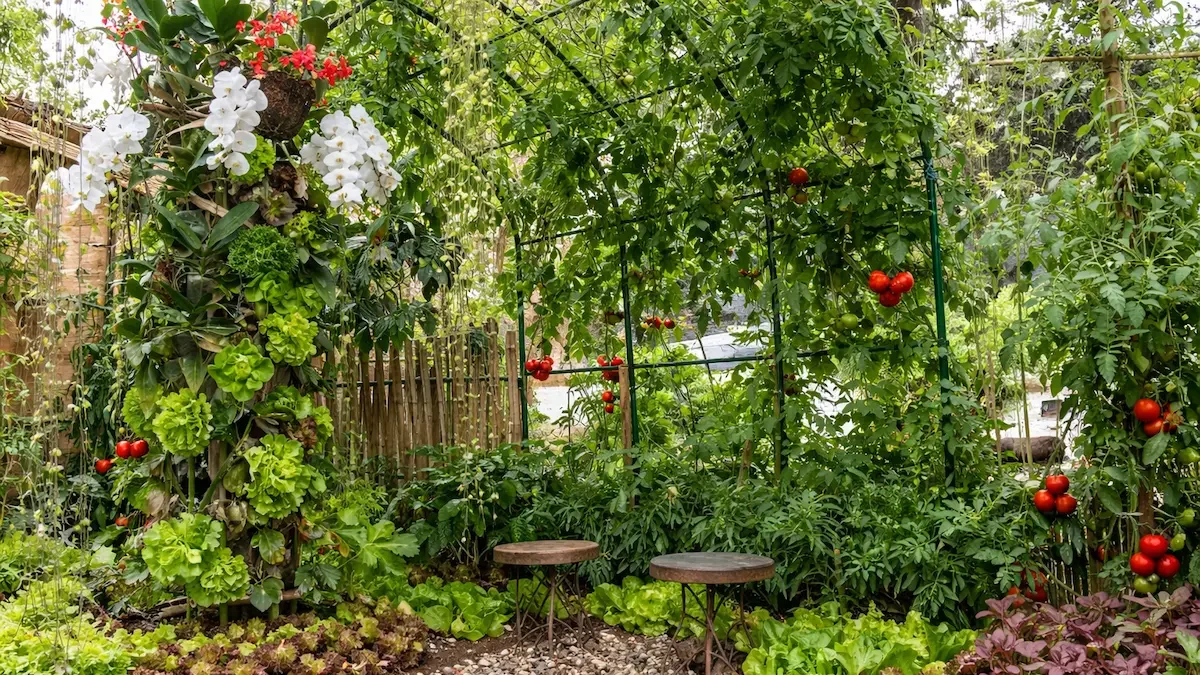
Most small gardens underperform not because of the space available but because the wrong crops fill it. The planning approach that consistently produces the most food from the least space is the same one used by experienced market gardeners: choose by yield and value per square foot, not by what looks good in a seed catalogue.
Quick Answer
Space needed: 150–200 sq ft per person for a steady supply of vegetables year-round. A 4-person household needs roughly 600–800 sq ft — less with raised beds and succession planting.
Best crops for a small plot: tomatoes, courgettes, climbing French beans, salad leaves, spinach, radishes, spring onions, and herbs. These give the highest food return relative to the space they use.
The single biggest planning mistake: growing space-hungry, low-yield crops (sweetcorn, pumpkins, maincrop potatoes) before filling the plot with high-return crops first.
According to Washington State University Extension’s home vegetable gardening research, which compared the relative quality, productivity, and monetary value of commonly homegrown vegetables, the best-performing crops consistently combine high yield per unit of space with a significant quality or cost advantage over what is available in shops. Tomatoes, courgettes, salad leaves, and climbing beans all score well on this basis. Large space-consuming crops like sweetcorn, maincrop potatoes, and winter squash score poorly — not because they cannot be grown at home, but because the food they produce per square foot of garden occupied is low compared to what that same space could yield in salad crops or courgettes.
The Four Planning Steps
Start with what you actually eat.
Start with what you actually eat. Write a list of the vegetables your household eats most frequently. A garden that produces food you don’t eat is wasted space regardless of yield. This list is the foundation of your crop selection.
Prioritise crops that are expensive to buy or far better fresh
Tomatoes eaten an hour after picking taste measurably different from supermarket ones. Salad leaves bought in bags cost significantly more per serving than growing your own. These crops return the highest value relative to their space.
Calculate space from yield, not from plant counts
University of Florida / IFAS Extension confirms that raised bed square-foot gardening typically produces more food per unit of area than traditional row gardening — because it eliminates row-spacing that serves only machinery. In a raised bed, 16 carrots, 4 lettuce heads, or 1 courgette plant fit in a single square foot. Plan by how much food each square foot will produce, not by how many plants seem to fit.
Plan for succession, not just for the first sowing
A single planting of radishes occupies ground for 4 weeks then is done. That same bed can then grow spinach, then a late sowing of French beans. MSU Extension’s vegetable production chart lists row requirements per person as a starting point — but succession planting can double or triple the food from the same area.
Best and Worst Crops for a Small Garden
| Crop | Space per Person | Return per Sq Ft | Verdict |
|---|---|---|---|
| Salad leaves (cut-and-come-again) | 3 ft of row | Very high — multiple cuts from same plant | Excellent — grows fast, high value, suits small beds |
| Courgettes | 1–2 plants | High — prolific producer from mid-summer | Excellent — 1 plant can feed a household if managed |
| Climbing French beans | 5 ft of row | High — vertical growth frees ground space | Excellent — use vertical space, long harvest window |
| Tomatoes | 2–3 plants | High — especially indeterminate varieties on supports | Excellent — quality far exceeds anything available in shops |
| Radishes | 1 ft of row × 3–4 sowings | Very high — 4-week turnaround, succession frees ground | Excellent — fastest ground-to-table crop in the garden |
| Sweetcorn | Needs block of 12+ plants for pollination | Low — large footprint for 1–2 ears per plant | Poor choice for small gardens — space cost too high |
| Pumpkins / winter squash | Sprawling vines, 6–10 sq ft per plant | Low — one fruit per large footprint | Poor unless vertical support used; better bought in bulk |
| Maincrop potatoes | 10 ft of row | Low — heavy space use for cheap-to-buy crop | Better value growing new/salad potatoes (faster, smaller) |
✗ Planning Mistakes That Waste Space
- Filling the plot with space-hungry crops before high-return ones— sweetcorn, pumpkins, and maincrop potatoes can occupy 60–70% of a small garden while producing food you can buy cheaply. Reserve these for space you have after covering essentials.
- Growing everything at once instead of in succession— a single sowing of lettuce produces a two-week glut then nothing. Three smaller sowings three weeks apart gives a steady supply for two months from the same area.
- Not using vertical space— climbing beans, cucumbers, and indeterminate tomatoes all grow upward. A 6-foot obelisk or wigwam doubles the food you can produce from a 1 sq ft footprint.
📅 This Week
- Write your household’s most-eaten vegetables
- Identify which are expensive to buy or much better fresh
- Measure your available space in square feet
- Allocate highest-return crops to the best-lit area first
📆 Before Sowing
- Plan 3 succession sowings of salad, radishes, and spinach
- Assign vertical supports to beans, cucumbers, tomatoes
- Leave out sweetcorn, pumpkins, maincrop potatoes unless space permits
- Keep a harvest log this year to improve next year’s plan