
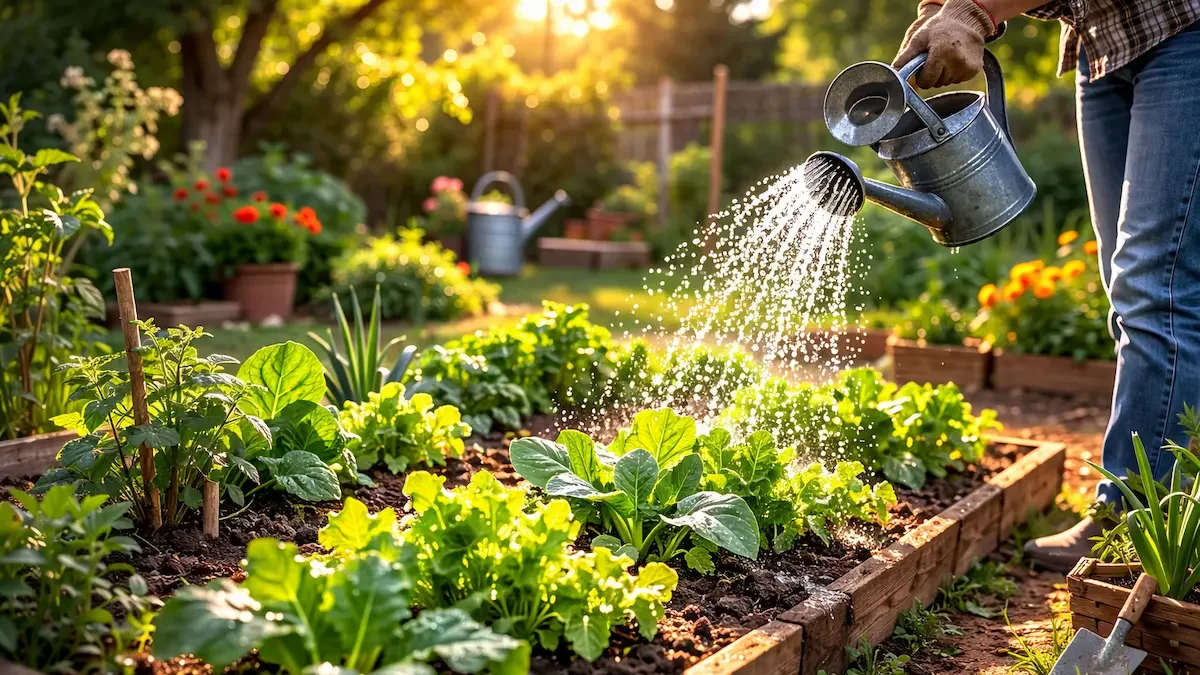
Morning is the best time to water — but the reason is more specific than most gardening advice explains. It is not about roots absorbing more water in the morning. It is about giving wet foliage time to dry before nightfall, when conditions for fungal disease are most favourable.
Quick Answer
Best time: early morning, 6–9am. Foliage dries before nightfall, reducing fungal disease risk. Less water lost to evaporation than midday. Plants well-hydrated before peak heat.
Exception — drip irrigation and soaker hoses: when water goes only to soil and never touches foliage, morning vs evening matters much less. Evening watering at the root zone is acceptable and reduces midday evaporation.
Worst time: midday in warm weather — up to 30–50% of water lost to evaporation before reaching roots. Never water overhead in full afternoon sun.
According to Iowa State University Extension, early morning — between 5:00 and 9:00am — is the best time to water when using a sprinkler or any method that wets plant foliage. Foliage dries quickly as the day warms, guarding against fungal disease, and water soaks more deeply into soil before midday evaporation rises. For drip systems and soaker hoses that keep foliage dry, Iowa State Extension notes that mornings and evenings are both equally suitable.
Why the Time of Day Actually Matters
The two key factors are disease risk and evaporation. Disease risk is more important for vegetables: wet foliage overnight creates conditions in which Botrytis, downy mildew, and bacterial diseases thrive. Courgettes, tomatoes, cucumbers, peas, and beans are all susceptible. Morning watering gives leaves a full day of warmth to dry. Evening overhead watering leaves them wet from dusk through to morning — up to twelve hours of ideal disease conditions.
Evaporation is the secondary factor. Old Farmer’s Almanac notes that watering in afternoon heat above 90°F can lose up to 50% to evaporation. In early spring with cooler temperatures this is less severe — but midday watering in direct sun remains less efficient than morning.
Timing by Watering Method
| Method | Best Time | Acceptable | Avoid |
|---|---|---|---|
| Hosepipe or sprinkler (overhead) | Morning 6–9am | Early evening if foliage dries before dark | Midday in sun; late evening (foliage stays wet overnight) |
| Watering can at base of plants | Morning preferred | Evening acceptable — keep water off leaves | Midday in full sun — high evaporation from soil surface |
| Soaker hose or drip irrigation | Morning or evening equally | Any time — foliage stays dry throughout | Midday only slightly less efficient — not harmful |
| New transplants (first week) | Morning and evening both | Any time if soil is drying rapidly | Never let newly transplanted roots dry completely |
The Early Season Difference
In early spring, the case for strict morning watering is somewhat weaker than in summer. Temperatures are lower, meaning evaporation is slower and foliage may already be damp with morning dew. Fungal disease pressure is lower than in warm, humid summer conditions. Old Farmer’s Almanac’s watering guide (Sept. 2025) notes that if you cannot water in the morning, evening is fine — the key is to avoid midday watering in heat and to avoid leaving foliage wet overnight when disease-prone crops are at risk.
The early season situation where timing matters most is for new transplants in the first 7–10 days after planting. These plants draw moisture only from their small root ball and have not yet grown into surrounding soil. A single morning watering may be sufficient in cool conditions. In windy or unexpectedly warm weather, a second early evening watering at the base — keeping foliage dry — is appropriate and carries no meaningful disease risk.
✓ Good Watering Practice in Early Spring
- Water deeply and less frequently— water that penetrates 5–6 inches encourages roots to follow it downward, building drought resilience. Shallow daily watering keeps roots near the surface
- Water at the base, not overhead— a watering can directed at the soil rather than the leaves is better practice regardless of time of day
- Check soil moisture before watering— push a finger 2 inches into the soil. If it is still damp, do not water. Overwatering in cool spring soil encourages damping-off fungi
- Mulch after seedlings emerge— a 2-inch layer of compost or straw around established plants reduces surface evaporation by up to 70% and means you water less frequently at any time of day
✗ Watering Mistakes in Early Season
- Watering on a schedule rather than on need— cool spring temperatures mean soil dries more slowly than in summer. Check before watering; cold wet soil encourages root rot
- Watering overhead late in the evening— wet foliage overnight is the most preventable cause of grey mould, downy mildew, and blight in spring gardens
- Watering lightly every day— frequent shallow watering creates shallow roots and wet surface conditions. Water deeply every 2–3 days unless newly transplanted
Daily Practice
- Water in the morning when possible — 6–9am
- Check soil at 2-inch depth before watering
- Direct water to base of plants, not foliage
- New transplants: check morning and evening
Longer Term
- Mulch established plants — dramatically reduces watering frequency
- Consider soaker hose or drip for disease-prone crops
- Water deeply 2–3 times a week, not shallowly every day
- Monitor for overwatering signs: yellowing, soft stems at soil line