
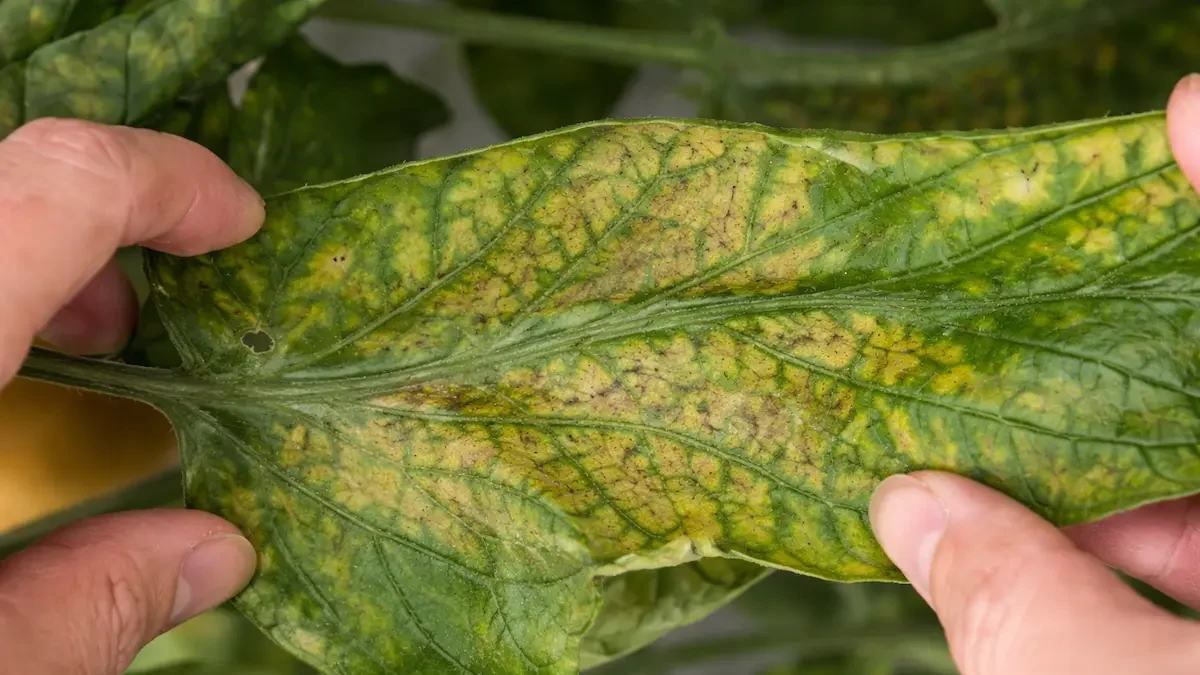
Purple leaves on young tomatoes. Yellow lower leaves on courgettes. Brown leaf margins on beans. All of these are common spring sights — and most of them are not caused by the soil lacking nutrients. They are caused by cold soil preventing the plant from absorbing nutrients that are already there.
Quick Answer
Old leaves showing symptoms first — nitrogen, phosphorus, potassium, or magnesium deficiency. These are mobile nutrients that the plant moves to new growth when supply is short, leaving older leaves visibly depleted.
New leaves showing symptoms first — calcium, iron, boron, or zinc deficiency. These are immobile nutrients that cannot be moved once fixed in tissue, so new growth shows the shortage first.
The spring rule: before applying any fertiliser, check soil temperature. If it is below 50°F (10°C), nutrient uptake is impaired regardless of soil fertility. Warming the soil solves most spring deficiency appearances.
According to University of Maryland Extension, nutrient deficiency in seedlings is a common problem in early spring — not because nutrients are absent, but because cool soil temperatures inhibit the microbial activity that makes nutrients available to roots. Root systems are also immature in spring transplants. This happens on all soils but is more pronounced where organic matter is low. The practical consequence: many spring deficiency symptoms are temporary and resolve as soil warms — and applying fertiliser before soil reaches working temperature is largely wasted.
The Diagnostic Rule — Old Leaves vs New Leaves
UConn Home and Garden Education Center’s April 2025 guide identifies the first diagnostic step: determine whether symptoms appear on older lower leaves or younger upper leaves. Symptoms on old leaves indicate a mobile nutrient deficiency — the plant pulls the resource from mature tissue to support new growth. Symptoms on new leaves indicate an immobile deficiency — the nutrient cannot be relocated once deposited, so new growth goes short first. This single observation prevents the most common mistake: applying nitrogen to a plant that actually has an iron problem.
Symptoms, Causes, and Fixes
| Symptom | Where It Appears First | Likely Deficiency | Spring-Specific Cause | Fix |
|---|---|---|---|---|
| Yellowing leaves, pale green overall | Old / lower leaves | Nitrogen | Cold soil slows mineralisation of organic nitrogen. Common on transplants before soil warms | Wait for soil to warm above 50°F. If persistent: liquid feed (fish emulsion or seaweed) applied to root zone |
| Purple or reddish colouration on leaves and stems | Old / lower leaves | Phosphorus | UGA Extension: phosphorus deficiency occurs in cold, wet soils or when planted too early. Most common cause in spring is soil below 65°F | Do not apply phosphorus fertiliser to cold soil — it will not be absorbed. Wait; symptoms resolve as soil warms. If pH is low, correct that first |
| Brown or yellow margins on older leaves | Old / lower leaves | Potassium | Sandy soils lose potassium by leaching over winter. Common on light soils after a wet spring | Compost top-dressing improves potassium retention long-term. Short-term: apply potassium sulphate or organic potash to soil surface |
| Yellow leaves with green veins (interveinal chlorosis) | New / upper leaves | Iron | UMD Extension: iron chlorosis caused by soil pH above 7.0. Iron is present but unavailable at alkaline pH | Test soil pH. If above 7.0, incorporate sulphur to lower pH. Chelated iron foliar spray gives short-term correction |
| Black or brown lesion on blossom end of fruit | Fruit (tomatoes, courgettes) | Calcium (blossom end rot) | Usually not calcium deficiency in soil. Caused by irregular watering preventing calcium uptake — common in early season with dry spells | Maintain consistent soil moisture. Mulch to reduce fluctuation. Foliar calcium spray gives temporary relief; fix watering first |
What to Do
Correct Order of Investigation
- Check soil temperature first— below 50°F (10°C), most spring symptoms resolve as soil warms. Fertilising cold soil is ineffective and risks salt accumulation
- Check soil pH— most vegetables need pH 6.0–7.0. Iron, manganese, and boron become unavailable above pH 7.0 regardless of what is in the soil
- Apply foliar feed for immediate correction—UMD Extension recommendsa balanced soluble fertiliser to leaves and root zone when cold soil prevents normal absorption. Apply in early morning when stomata are open
- Add compost before the next season— recurring deficiencies usually indicate low organic matter. Regular compost additions improve both nutrient content and microbial activity
Common Mistakes
- Applying nitrogen to purple-leaved transplants— purple leaves in spring are almost always a phosphorus or cold-soil problem, not nitrogen deficiency
- Adding fertiliser without checking pH— if pH is wrong, adding more of the deficient nutrient achieves little. Correct pH first
- Diagnosing deficiency when the problem is overwatering—Montana State Extension notesthat overwatering and disease produce similar symptoms. Check root health before fertilising
Right Now
- Check soil temperature at 2-inch depth
- Identify whether symptoms are on old or new leaves
- Test pH if iron chlorosis or persistent problems
- Apply liquid feed at root zone if soil is warm enough
Longer Term
- Top-dress with compost to improve long-term fertility
- Correct pH before next growing season if needed
- Note where symptoms appeared for targeted soil testing
- Avoid planting out tender crops before soil reaches 50°F