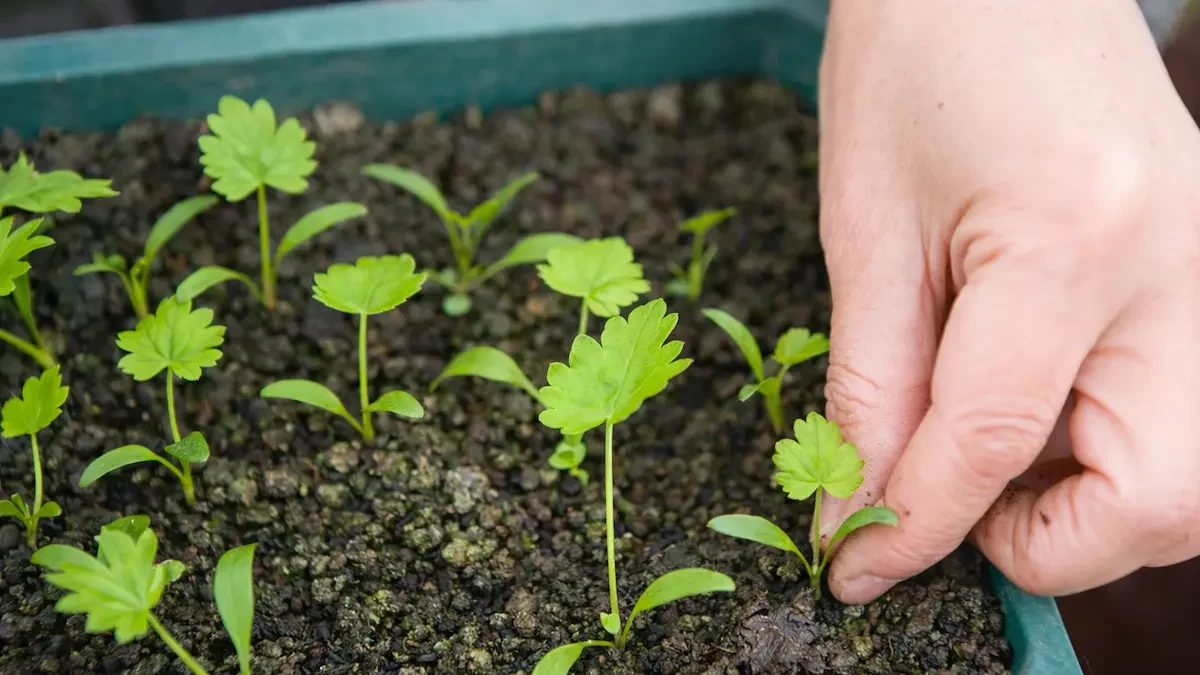
Most thinning mistakes come from pulling. The roots of crowded seedlings intertwine below soil level within days of germination — pulling one out tugs the root system of its neighbours. The fix is simple and takes the same time: cut the stem at soil level and leave the roots to decompose.
Quick Answer
When to thin: when seedlings have one to two sets of true leaves — the second pair to appear after the seed leaves. Too early and you are guessing which will be strongest; too late and roots are deeply entangled.
How to thin: cut the unwanted seedling at soil level with sharp, clean scissors. Do not pull. The cut roots decompose and release nutrients to the remaining plant.
Which seedling to keep: the one with the thickest stem. If several look equal, keep the most central plant in the cluster — it will have the most symmetrical root space available to it.
According to Seed Savers Exchange, the best practice when thinning is to snip rather than rip — cutting stems at soil level with scissors rather than pulling them out. If roots are connected to the seedlings you are keeping, pulling out those you want to remove risks displacing the root systems of the ones you want to keep. The severed roots of cut seedlings will decompose in the soil, releasing their nutrients to the remaining plant. There is no downside to leaving them — and no benefit to pulling them.
Why Thinning Cannot Be Skipped
Plants detect neighbours before visible crowding occurs. Canada’s Local Gardener (June 2025) explains: through shade avoidance syndrome, seedlings detect changes in light wavelengths reflected off nearby plants and respond by stretching taller, developing fewer leaves, and flowering earlier — all before visible competition has begun. Research in plant physiology confirms that crowded seedlings shift energy to vertical growth at the expense of lateral root development, producing tall, weak plants with shallow roots.
Fine Gardening’s thinning guide is direct about root vegetables: beets left unthinned produce all tops and no roots. Crowded carrots produce forked, misshapen roots. Chard not thinned produces spindly leaves and bolts early. For these crops, thinning is not optional — the useable harvest depends directly on it.
Method by Crop Type
| Crop Type | Best Method | Timing | Notes |
|---|---|---|---|
| Root crops (carrots, beetroot, parsnips) | Cut at soil level | At 1–2 true leaves; do not delay | Pulling releases carrot scent attracting carrot fly. Remove thinnings from the bed; do not leave on the soil surface |
| Peas, beans, cucurbits (courgettes, cucumbers) | Cut immediately after germination | As soon as overcrowding is visible | Fragile roots entangle fast. If you wait until plants are several centimetres tall, cutting is the only safe option |
| Lettuce, salad leaves, spinach | Can pull if soil is damp | At 1–2 true leaves | Thinnings are edible — use in salads immediately. Less root sensitivity than root crops |
| Radishes | Cut or use rake method | Early — as soon as seedlings are 1–2cm tall | For large sowings: drag a garden rake lightly on the diagonal across the bed in two directions to uproot a proportion without disturbing the rest |
| Tomatoes, peppers, aubergines (in cell trays) | Separate and pot on, or cut | At 1 true leaf, before roots intertwine | Hold by leaf, not stem. Insert dibber beside seedling and lever gently. Both plants can survive separation at this stage if done carefully |
What to Do With Thinnings
Many thinnings are edible. Local Gardener identifies beet greens, radish, spinach, and bok choy thinnings as useful in salads or eaten like microgreens. Do not eat thinnings from nightshade plants — tomato, pepper, and aubergine foliage contains solanine and is toxic.
What to Do
- Thin at 1–2 true leaves— early enough that roots are still shallow, visible enough to judge health
- Always cut; pull only when soil is damp and the crop is tolerant— lettuce and spinach can be pulled gently; root crops and legumes should always be cut
- Disinfect scissors before starting— fungal pathogens introduced on a cut can travel through soil to remaining seedlings
- Thin in the evening or on a cloudy day— cooler conditions reduce stress on remaining plants
- Water immediately after— thinning loosens soil around remaining roots; watering resets soil contact
Common Mistakes
- Pulling root crops or legumes— the intertwined roots of carrots, peas, and beans mean pulling one seedling disturbs its neighbours, sometimes fatally
- Thinning too late— seedlings left to compete until they are several centimetres tall have developed substantial root entanglement. Earlier thinning causes less disturbance and produces better results
- Leaving thinned carrot seedlings on the soil surface— bruised carrot foliage releases volatile compounds that attract carrot fly. Remove thinnings from the bed entirely
- Not thinning at all to avoid waste— overcrowded seedlings produce worse results than well-thinned ones every time. The thinned plant you remove is not wasted; it is an investment in the one that remains
Right Now
- Check all trays and beds for crowding at 1–2 true leaves
- Disinfect scissors before starting each tray
- Cut at soil level — do not pull root crops or legumes
- Water after thinning to resettle soil
Ongoing
- Thin in stages if unsure — remove obviously weak ones first
- Eat edible thinnings the same day — beet, spinach, radish
- Remove carrot thinnings from the bed; do not leave on surface
- Final spacing: use seed packet plant spacing, not row spacing