
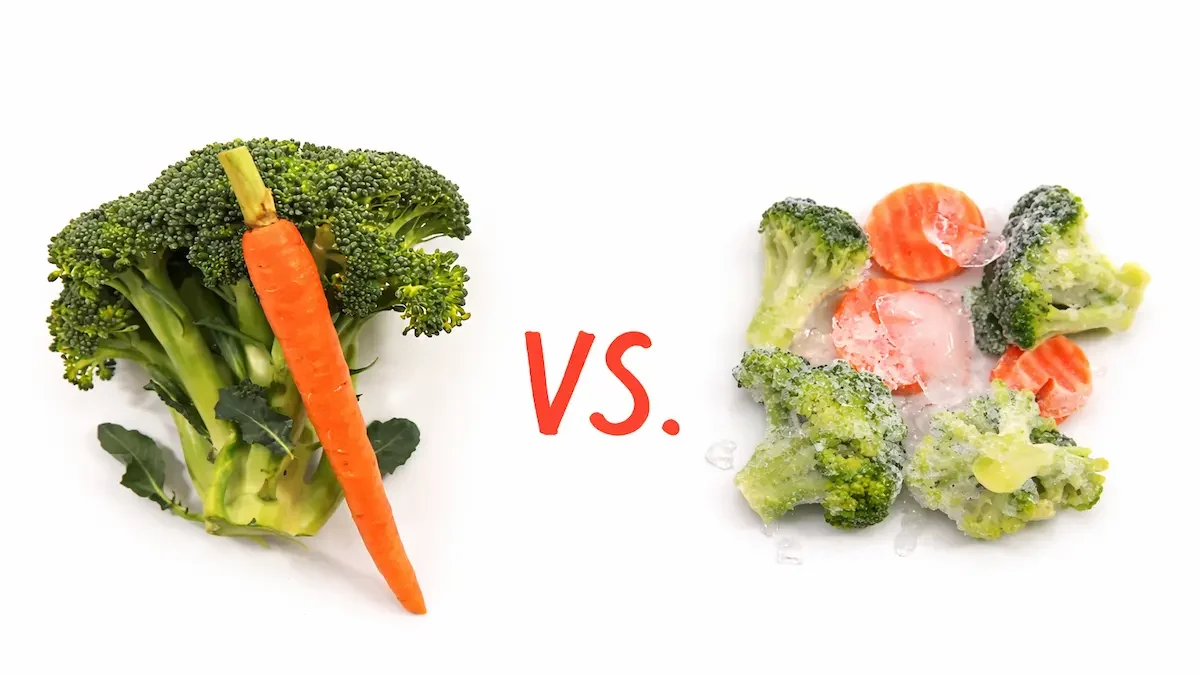
The fresh versus frozen debate is mostly about supermarket produce. For home growers, the question is different: how do garden vegetables eaten the same day compare to those eaten after several days in the fridge, or after blanching and freezing? The research on this point is clear and more useful than the general debate.
Quick Answer
Same-day harvest: nutritional content is at its peak. Vitamin C begins to decline immediately after harvest. Green peas lose up to 51% of their vitamin C within 24–48 hours at ambient temperature. Homegrown vegetables eaten within hours of lifting occupy a category that no supermarket product — fresh or frozen — can match.
Garden vegetables stored for several days: lose significant water-soluble vitamins (C and some B vitamins) but retain fat-soluble vitamins (A, E, K), minerals, fibre, and most antioxidants. After five days in the fridge, vitamin content is broadly similar to a well-frozen equivalent.
Blanched and frozen homegrown produce: blanching removes 10–50% of water-soluble vitamins, depending on the vegetable. After that, nutrient content is stable for 8–12 months. Frozen homegrown vegetables processed within hours of harvest are nutritionally superior to the same vegetables stored fresh for five or more days.
According to a University of Georgia study led by Ronald Pegg (August 2025), vitamins and nutrients in fruits and vegetables degrade over time, and frozen fruits and vegetables may offer more nutrition than fresh when storage is taken into account. Pegg’s team analysed vitamin A, vitamin C, and folate in eight vegetables at three points: day of purchase, after five days of refrigeration, and in frozen samples. In some cases, frozen produce had higher levels of vitamin A, C, and folate than the same vegetables stored for five days — findings that challenge the widespread consumer belief that fresh is always more nutritious than frozen.
Where Homegrown Vegetables Stand Apart
The UGA study used commercially purchased fresh produce that had already spent days in transit before the study began. Homegrown vegetables eaten the same day are in an entirely different category. Green peas lose up to 51% of their vitamin C in the first 24–48 hours after harvesting. Fresh spinach loses a significant proportion of its vitamin C within days of refrigeration. These losses begin from the moment of harvest — meaning the gap between a pea eaten within an hour of picking and one eaten after four days in the fridge is larger than the gap between a four-day-old fresh pea and a well-frozen one.
The practical implication: the greatest nutritional advantage of growing your own comes not from avoiding frozen produce, but from the ability to eat vegetables within hours of harvest — a timing unavailable through any retail channel. The debate between supermarket fresh and frozen is largely irrelevant to the home grower who eats directly from the garden.
Which Nutrients Are Affected — and How Much
| Nutrient | Stability in Fresh Storage | Effect of Blanching | Frozen Storage (up to 12 months) |
|---|---|---|---|
| Vitamin C (ascorbic acid) | High loss — begins immediately after harvest; fridge slows but does not stop decline | Losses of 10–50% depending on vegetable and blanch time | Stable once frozen — little further loss during storage |
| Folate (B9) | Declines with storage; frozen often higher than 5-day-stored fresh | Moderate loss during blanching | Reasonably stable in frozen storage |
| Beta-carotene (provitamin A) | Generally stable in fridge; may increase in some crops as ripening continues | Steam blanching causes little or no loss | Decreases in frozen peas, carrots, and spinach over 12 months |
| Vitamin E (alpha-tocopherol) | Generally stable during cold storage | Some loss; varies by vegetable | Retained well — often similar or higher than fresh-stored equivalents |
| Minerals (potassium, calcium, iron) | Stable — not significantly affected by storage | Minimal loss during blanching | Well retained at 90–95% of original content |
| Fibre | Fully stable during storage and freezing | No significant loss | Retained at 90–95% |
What to Do
- Eat the most nutrient-sensitive crops the day they are harvested— peas, spinach, sweetcorn, and broccoli are the highest-loss crops. The nutritional advantage of growing your own is greatest when these are eaten within hours
- Freeze surplus the same day it is harvested— blanching and freezing on harvest day retains significantly more nutrients than the same vegetables stored fresh for 3–5 days and then frozen
- Store more stable crops in the fridge without concern— carrots, beetroot, winter squash, onions, and potatoes lose nutrients slowly in cold storage. There is no urgency to freeze these
- Do not over-blanch when freezing— blanch to the minimum time required for the specific vegetable. Most water-soluble vitamin loss from freezing occurs during blanching, not during frozen storage itself
Highest Priority — Eat Same Day
- Peas — 51% vitamin C loss in 24–48 hours
- Sweetcorn — sugar conversion begins immediately
- Spinach — 75% vitamin C loss within a week in fridge
- Broccoli — 56% vitamin C loss in 7 days at 20°C
Slower Decline — Store Normally
- Carrots, beetroot, parsnips — stable in cool dark storage
- Winter squash — fat-soluble vitamins stable for months
- Potatoes — vitamin C declines but minerals and fibre stable
- Onions, garlic — stable for weeks to months in dry storage