
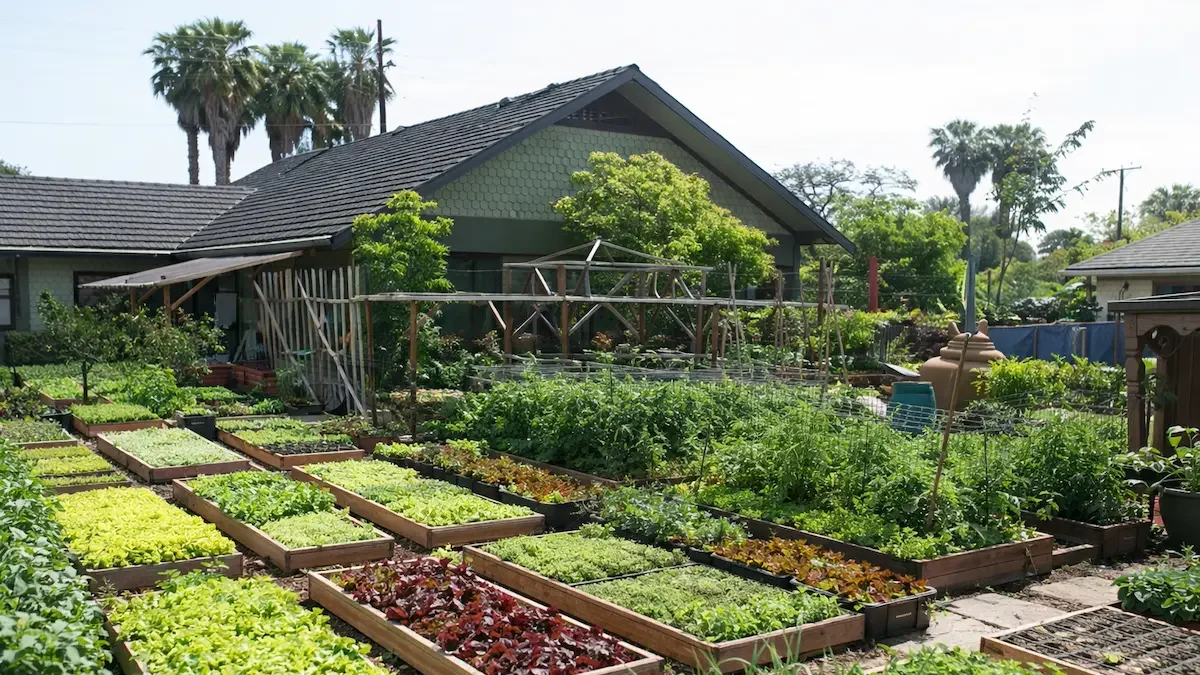
The question most beginners ask is: how much land do I need? The more useful question is: what do I want to produce, and how intensively am I prepared to manage it? A well-planned quarter-acre will outperform a neglected acre every time — and the research on this point is consistent.
Quick Answer
What less than one acre can realistically support: a productive vegetable garden feeding a household year-round with surplus to preserve or sell, a small flock of laying hens (6–12 birds), possibly a few meat rabbits, and a composting system that closes the fertility loop between animals and crops.
What it cannot support: grazing livestock such as sheep, goats, or pigs in any meaningful number — these require minimum areas of half an acre to one acre per animal pair, plus fencing, housing, and hay storage. Starting with grazing animals on a sub-acre holding is the single most common reason new smallholders become overwhelmed in the first year.
The key principle: start with the smallest version of what you actually want, produce it well, and expand. Start big and you are very likely to fail at the same scale you would have succeeded at if you had started smaller.
According to research cited by Addland’s smallholding guide, a 2008 Bard College study found that smaller plots produce more food per hectare than farms over 10 acres, because the land is used for multiple purposes rather than single arable crops. Jean-Martin Fortier at The Market Gardener has documented this in practice: intensive market gardening on under two acres using hand tools and good crop planning can generate a full-time income. The limiting factor is not size — it is planning, soil fertility, and the discipline to start smaller than you think you need to.
What a Sub-Acre Holding Can Realistically Do
| Activity | Space Required | What It Produces | Priority for Beginners |
|---|---|---|---|
| Intensive vegetable beds | 1,000–2,500 sq ft (raised beds or market garden rows) | Year-round vegetables for a household; surplus to sell or preserve | Start here — highest return per sq ft, lowest risk |
| Fruit trees and soft fruit | 600–1,500 sq ft depending on rootstock | Apples, pears, plums, currants, gooseberries — multi-year investment | Plant early; trees take time to establish but require little annual input |
| Laying hens (6–12 birds) | Coop: 30–60 sq ft. Run: 60–120 sq ft minimum | 4–8 eggs per day; manure for compost | Good starter livestock — low cost, manageable, provides fertility |
| Composting system | 60–120 sq ft for a twin-bay system | Continuous supply of compost for the growing area | Essential — closes the fertility loop between kitchen, chickens, and garden |
| Herb bed and perennials | 100–300 sq ft | Fresh herbs year-round; high-value preserves; cut flowers | Low effort, high value — plant once, harvest for years |
| Grazing animals (sheep, goats, pigs) | Minimum 0.5–1 acre per pair for grazing | Meat, milk, wool — significant output but significant input and space requirement | Not viable on sub-acre holding without supplementary bought-in fodder |
The Most Common Mistake on a Small Holding
The Shepherdess (March 2025) identifies the single most common reason new smallholders burn out: starting too big, too fast. Having established a successful sheep operation, the author added cows and goats in year two without a clear plan for either. The additional animals consumed all available resources without providing a return. The corrective was to remove the additions and return to the original focused plan. This pattern repeats consistently: the first year’s enthusiastic expansion becomes the second year’s crisis. Every enterprise added before the first is profitable increases the risk that none of them succeed.
What to Do
- Write down exactly what you want to produce before acquiring any animals or building anything— define the goal before the land shapes the decision for you
- Start with the vegetable garden in year one— a productive growing area provides food, fertility through compost, and the experience to judge what else is actually possible
- Add chickens in year two— once the growing system is established. Chickens provide eggs, pest control in rotation off vegetable beds, and manure for compost
- Check legal requirements before any livestock— in England and Wales, keeping sheep, goats, or pigs requires DEFRA registration and a County Parish Holding (CPH) number. Check local regulations before acquiring any animal
- Build the soil before you build anything else— a year of composting, green manures, and cover cropping before planting produces returns every subsequent year
Common Mistakes
- Acquiring grazing animals before establishing the growing system— livestock need feeding, housing, and veterinary care from day one. The growing system takes a season to establish. Doing both simultaneously in year one is the standard route to burnout
- Underestimating the infrastructure cost— fencing, water supply, animal housing, and tools represent the majority of first-year costs. Land cost is only part of the budget
- Assuming more land means more output— output follows intensity of management. A neglected acre produces less than a well-managed quarter-acre. The research on inverse farm-size productivity is consistent on this point
Year One Priorities
- Test soil; begin composting immediately
- Establish vegetable beds — prioritise fertility and soil structure
- Plant fruit trees early in the first autumn
- Assess infrastructure needs honestly before any livestock
Year Two Onwards
- Add chickens once growing system is producing reliably
- Expand vegetable area before adding livestock complexity
- Build a track record of sales before investing in market capacity
- Any addition: can this enterprise pay for itself within 12 months?