Mulching is one of the simplest ways to improve a vegetable garden, yet it’s often misunderstood. Many growers treat mulch as a generic layer applied at random, but the type of mulch — and when you use it — makes a significant difference to soil health, moisture retention, and crop performance.
A well-chosen mulch doesn’t just protect the soil. It actively improves it over time, reduces labour, and stabilises growing conditions in ways that are difficult to achieve otherwise.
What Mulch Actually Does
At its core, mulch acts as a protective barrier between the soil and the outside environment. It reduces evaporation, suppresses weeds, buffers temperature swings, and protects soil structure from heavy rain.
According to University of California mulch management guide, mulching can significantly improve water efficiency and reduce soil compaction — two factors that directly affect yield.
But not all mulches behave the same way. Some feed the soil, others mainly protect it, and some are better suited to specific seasons.
Compost — The Most Versatile Mulch
Compost is often overlooked as a mulch because people think of it only as a soil amendment. In reality, it is one of the best all-purpose mulches available.
It improves soil while protecting it. As it breaks down, it feeds microbial life and gradually releases nutrients.
Compost works best in spring and early summer when plants are actively growing and need nutrients. It’s particularly effective for crops like tomatoes, courgettes, and leafy greens.
Because it is relatively fine, it does not suppress weeds as aggressively as thicker mulches, but it creates ideal growing conditions.
Straw — The Classic Vegetable Mulch
Straw is one of the most widely used mulches in vegetable gardens for a reason. It is light, easy to apply, and highly effective at moisture retention.
It is especially useful in summer, when preventing evaporation becomes critical. Straw keeps soil cool and reduces the need for frequent watering.
It also works well for crops that sit on the soil surface, such as strawberries, courgettes, and pumpkins, keeping fruit clean and reducing rot.
The key is to use clean straw, not hay. Hay often contains seeds that can turn into a weed problem.
Wood Chips — Best for Long-Term Beds
Wood chips are often misunderstood in vegetable systems. While they are not ideal for annual beds, they are excellent for pathways and perennial areas.
They break down slowly, improving soil structure over time and supporting fungal activity.
Used around fruit trees, berry bushes, or permanent beds, wood chips provide long-term soil building with minimal maintenance.
However, they can temporarily tie up nitrogen at the surface, which is why they are less suitable for direct use around fast-growing annual vegetables.
Grass Clippings — Fast but Temporary
Fresh grass clippings are one of the most accessible mulches, especially during the growing season.
They provide a quick nitrogen boost and break down rapidly, feeding the soil.
However, they must be used carefully. Applied too thickly, they can form a dense, wet layer that blocks airflow and leads to rot.
Thin layers, applied regularly, work best. They are particularly useful for crops that benefit from steady nitrogen, such as leafy greens.
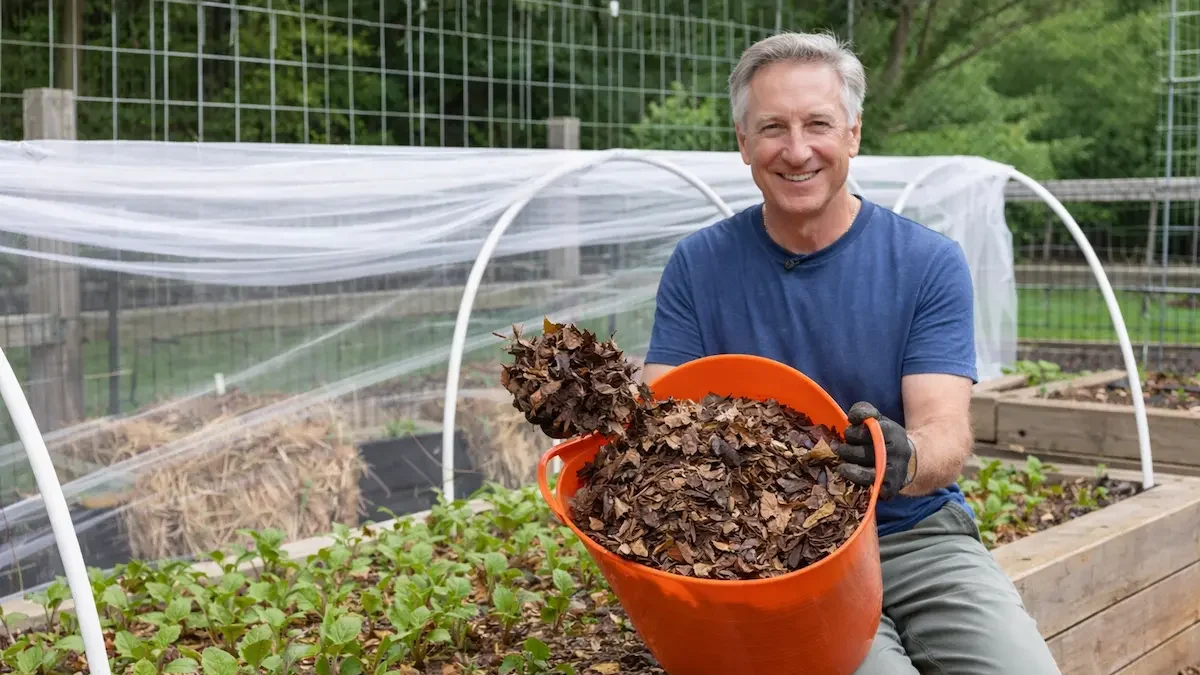
Leaves — The Autumn Resource
Fallen leaves are one of the most underused resources in a garden.
They are ideal for autumn mulching, protecting soil over winter and gradually breaking down into rich organic matter.
Shredded leaves work better than whole ones, as they settle more evenly and decompose faster.
Used in late season, they prepare beds for spring by improving soil structure and fertility without additional inputs.
Plastic and Fabric Mulches — Control Over Soil Conditions
Synthetic mulches such as black plastic or landscape fabric are often used in more intensive systems.
They are highly effective at:
- Suppressing weeds completely
- Warming soil in early spring
- Retaining moisture
These are particularly useful for heat-loving crops like tomatoes, peppers, and melons.
However, they do not improve soil structure and must be managed carefully. Over time, reliance on synthetic mulches without organic matter can reduce soil quality.
Timing Matters More Than Material
One of the biggest mistakes is applying mulch at the wrong time.
Mulching too early in spring can keep soil cold and slow plant growth. It’s better to wait until soil has warmed before applying thick layers.
In contrast, mulching before winter protects soil from erosion and nutrient loss.
The same material can have very different effects depending on when it is used.
Matching Mulch to the Season
A simple seasonal approach works best:
- Spring: light compost mulch to feed soil and support early growth
- Summer: thicker mulches like straw to retain moisture
- Autumn: leaves or compost to rebuild soil
- Winter: protective layer to prevent erosion and nutrient loss
Thinking in cycles rather than one-time application makes mulch far more effective.
Common Mistakes
Using mulch too thickly is one of the most common problems. Excessive layers can block air and water movement, creating poor growing conditions.
Applying mulch to dry soil is another issue. Mulch locks in existing moisture — if the soil is dry, it stays dry.
Mixing fresh wood materials directly into soil can also reduce available nitrogen, affecting plant growth.
Finally, treating all mulches as interchangeable leads to poor results. Each type has a role, and using the right one at the right time is what makes the difference.
A More Efficient Way to Think About Mulch
Mulch is not just a protective layer — it is part of a system.
When used correctly, it:
- Reduces watering needs
- Builds soil over time
- Suppresses weeds naturally
- Improves crop consistency
Instead of asking “What mulch should I use?”, a better question is:
“What does my soil need right now?”
Long-Term Impact
Over time, consistent mulching transforms soil. Organic matter increases, structure improves, and the need for external inputs decreases.
A well-mulched garden becomes easier to manage each year. Watering is reduced, weeds are fewer, and plants grow more consistently.
That is the real value — not just short-term protection, but long-term improvement.