
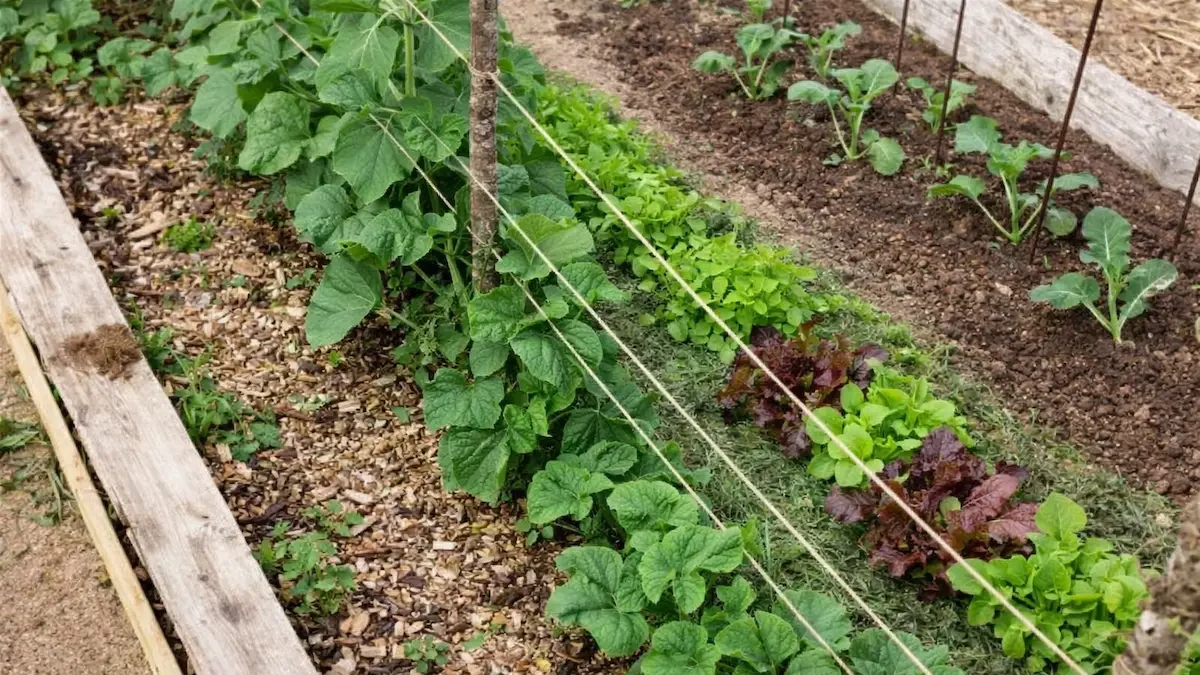
Most growers harvest a bed once and move on. But a well-managed bed can produce two — sometimes even three — crops in a single season. The difference is not more space or more effort. It’s timing, planning, and understanding how crops fit together.
A second harvest isn’t about squeezing more in randomly. It’s about using the natural gaps in the growing season.
The Core Idea: Replace, Don’t Pause
The biggest mistake is leaving beds empty after harvest. Even a gap of two or three weeks reduces total productivity significantly.
Instead of thinking:
“Harvest → rest → replant”
Think:
“Harvest → immediately replace”
This shift alone can double output from the same space.
According to University of Minnesota succession planting guide, continuous planting is one of the most effective ways to maximise yield in small spaces.
Timing Is Everything
To get a second harvest, you need to know when your first crop finishes — and plan the next one before that happens.
For example:
- Early potatoes harvested in June
- Followed immediately by beans, carrots, or brassicas
Or:
- Spring lettuce harvested in May
- Replaced with tomatoes, peppers, or courgettes
The key is overlap. Your second crop should already be growing (in trays or modules) before the first crop is removed.
Use Fast and Slow Crops Together
The most efficient systems combine crops with different growth speeds.
Fast crops (20–40 days):
- Lettuce
- Radishes
- Spinach
Slow crops (80–120+ days):
- Tomatoes
- Cabbage
- Leeks
You can grow a fast crop first, harvest it early, and then replace it with a slower, main-season crop.
Or reverse it — follow a slow crop with a fast one at the end of the season.
The Mid-Season Window Is the Opportunity
The most overlooked period is mid-summer.
Beds cleared in June or July still have plenty of growing time left. Many growers miss this window and lose a full second harvest.
Good second crops for this period include:
- French beans
- Beetroot
- Carrots
- Kale and other brassicas
- Salad crops
The RHS succession planting advice highlights that many crops can be sown well into summer and still produce reliable yields.
Soil Preparation Between Crops
One reason people avoid second planting is the assumption that soil needs a long recovery period.
In reality, you only need minimal preparation:
- Remove old crop residues
- Add a layer of compost
- Lightly loosen the surface
Because the root system is already established and soil structure is intact, second crops often establish faster than the first.
Transplants vs Direct Sowing
To save time, use transplants wherever possible.
Instead of sowing seeds after harvest and waiting for germination, you can:
- Start seedlings in trays while the first crop is still growing
- Transplant immediately after clearing the bed
This can save 2–3 weeks — which is often the difference between success and failure for a second crop.
Matching Crops to Season Length
The success of a second harvest depends on choosing crops that can mature in the remaining time.
Ask one simple question:
“How many frost-free days are left?”
Then choose crops that fit within that window.
Short-season varieties are especially useful here. Many crops have faster-maturing versions specifically suited for late planting.
Water and Nutrient Reset
After the first crop, soil nutrients are partially depleted.
A quick reset helps:
- Add compost or organic fertiliser
- Water thoroughly before replanting
This ensures the second crop doesn’t start under stress.
A More Strategic Way to Plan Beds
Instead of planning one crop per bed, plan the entire season in advance.
Example:
- Spring: spinach
- Summer: tomatoes
- Autumn: salad leaves
This turns one bed into a continuous production system rather than a single-use space.
Common Mistakes
The biggest mistake is waiting too long after harvest. Even a short delay reduces the viability of a second crop.
Another is choosing crops that take too long to mature. Late planting of slow crops often leads to poor results.
Not preparing seedlings in advance is also a common issue. Without ready transplants, valuable time is lost.
Finally, ignoring soil nutrition between crops leads to weaker second harvests.
A Different Way to Think About Productivity
Most people measure productivity per plant. A better way is to measure productivity per bed per season.
A bed that produces twice is far more efficient than one that produces once — even if each individual crop is slightly smaller.
Long-Term Impact
Once you adopt this approach, your entire system changes.
You start thinking in sequences, not single crops. Beds become part of a continuous cycle rather than isolated events.
Over time, this leads to:
- Higher total yield
- Better use of space
- More consistent harvests
And importantly, it doesn’t require more land — just better timing.
If you get this right, a small growing area can produce far more than expected, simply by removing the gaps between crops.