
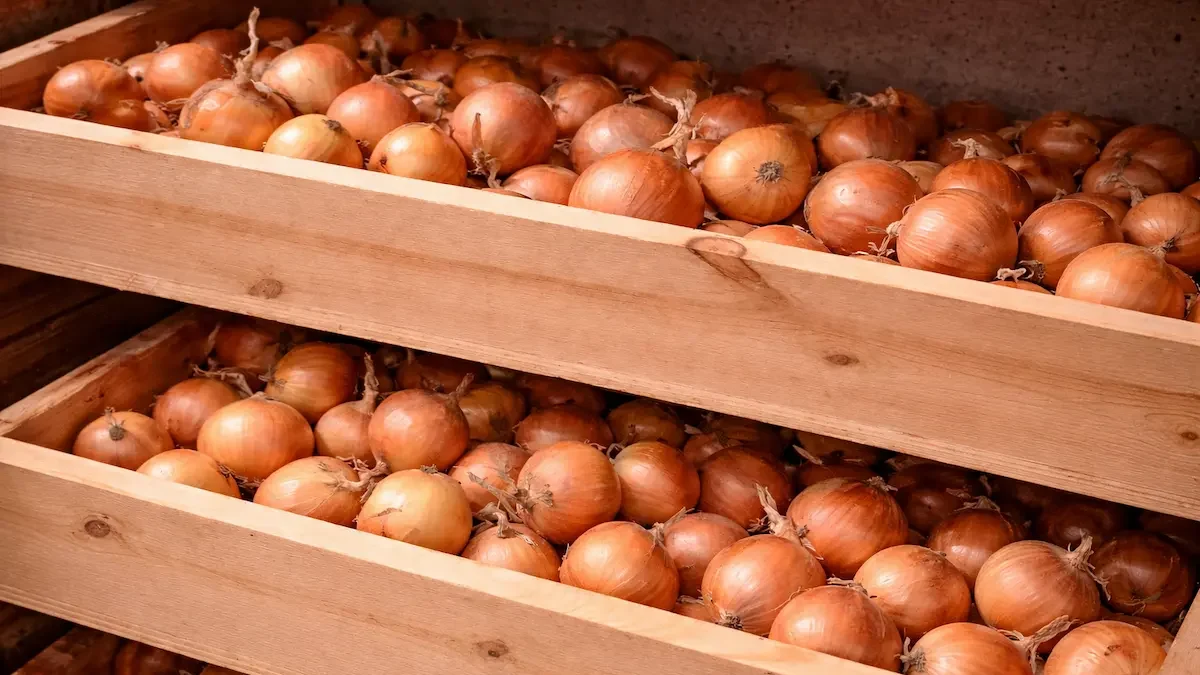
Storing onions and garlic properly is what turns a good harvest into a reliable winter food supply. Done right, they last for months with almost no loss. Done poorly, they soften, sprout, or rot long before you get to use them.
The difference comes down to one thing: curing and conditions. Most storage problems start before the crop even goes into storage.
The Most Important Step: Proper Curing
Freshly harvested onions and garlic are not ready for storage. They contain too much moisture, especially in the neck (the area where the leaves meet the bulb).
Curing allows the outer layers to dry and form a protective skin.
According to University of Minnesota onion storage guide, proper curing is essential for long-term storage and prevents rot during winter.
To cure:
- Harvest in dry weather
- Lay bulbs out in a single layer
- Keep in a warm, dry, well-ventilated place
- Leave for 2–3 weeks
They’re ready when:
- Skins are papery
- Neck is completely dry
- Roots are shrivelled
Skipping this step is the main reason onions fail in storage.
Trim and Prepare for Storage
Once cured:
- Cut tops down to 2–3 cm (or leave for braiding)
- Remove loose dirt (don’t wash)
- Discard damaged or soft bulbs
Only fully healthy bulbs should go into long-term storage. Even one bad onion can spread rot.
The Ideal Storage Conditions
Onions and garlic store best in very specific conditions:
- Cool (0–5°C ideal, but up to ~10°C works)
- Dry (low humidity is critical)
- Dark (prevents sprouting)
- Well ventilated (airflow prevents moisture buildup)
The USDA post-harvest storage guidelines emphasise that low humidity and airflow are just as important as temperature for preventing spoilage.
Warm + humid = rot
Cold + damp = mould
Stable + dry = long storage
Where to Store Them
Good storage locations include:
- Sheds or outbuildings
- Garages (if not too damp)
- Pantries with airflow
- Cellars (only if dry)
Avoid:
- Refrigerators (too humid)
- Plastic containers (trap moisture)
- Sealed boxes
Traditional methods work best — open crates, mesh bags, or hanging strings.
Storage Methods That Actually Work
Airflow is the priority, not neatness.
Effective options:
- Wooden crates with gaps
- Mesh or net bags
- Hanging braids (especially for garlic)
- Single layers on shelves
The key rule: no crowding and no trapped moisture.
Onions stored in deep piles are far more likely to rot because airflow is restricted.
Onion vs Garlic: Slight Differences
While similar, they behave slightly differently in storage.
Onions:
- Prefer slightly cooler conditions
- More sensitive to moisture
- Store longer if fully cured
Garlic:
- Tolerates slightly warmer conditions
- Stores well in braids
- Softneck varieties store longer than hardneck
Understanding this helps fine-tune your storage setup.
What Shortens Storage Life
Several common mistakes reduce storage time dramatically:
Poor curing — the biggest issue
High humidity — leads to mould and rot
Temperature fluctuations — encourage sprouting
Storing damaged bulbs — spreads decay
Lack of airflow — traps moisture
Most failures are not random — they come from one of these factors.
Checking During Winter
Storage is not “set and forget.”
Check bulbs every few weeks:
- Remove any soft or rotting ones
- Watch for sprouting
- Ensure airflow is still good
A quick check prevents small problems becoming large losses.
A More Practical Way to Think About It
Onions and garlic don’t need special storage — they need dry, stable conditions.
You’re not preserving them artificially. You’re maintaining the conditions they were adapted to after drying in the field.
Once cured properly, they are naturally long-lasting.
How Long They Should Last
With good storage:
- Onions: 3–6 months (sometimes longer)
- Garlic: 4–8 months depending on variety
If they’re failing early, the issue is almost always curing or humidity.
Long-Term Perspective
Once you get this right, storage becomes predictable. You stop losing crops mid-winter and start relying on what you grow.
It’s one of the simplest upgrades you can make to a smallholding system — and one of the most valuable.
Good storage doesn’t require expensive equipment. It requires understanding what the crop needs after harvest — and maintaining those conditions consistently.