
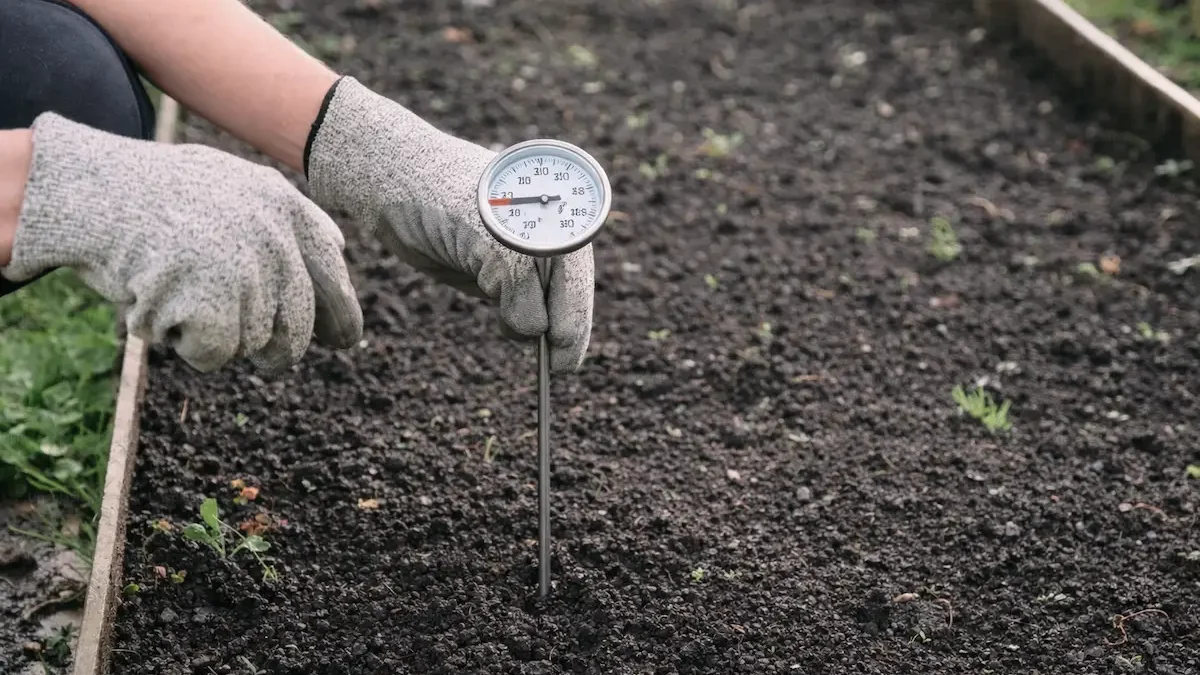
Seed packets say “plant after last frost.” Soil temperature is the real trigger. A $10 probe thermometer eliminates more planting failures than any other tool in the garden.
Most seed germination failures trace back to soil temperature, not timing on the calendar. According to research from the University of California, Davis Department of Vegetable Crops, every vegetable seed has a minimum, optimum, and maximum soil temperature for germination. Plant outside that range and seeds either rot in cold, wet ground or cook in overheated soil. Michigan State University Extension confirms that cool-season crops germinate at minimums of 35–40°F, while warm-season crops need 60°F or higher. The difference between a March sowing that germinates in 7 days and one that sits for 5 weeks is not the seed — it is the soil.
The short answer: Measure soil temperature at 2-inch depth, at 9 a.m., for 7 consecutive days. Use the average. Match it to the crop’s minimum germination temperature before sowing.
How to Measure Correctly
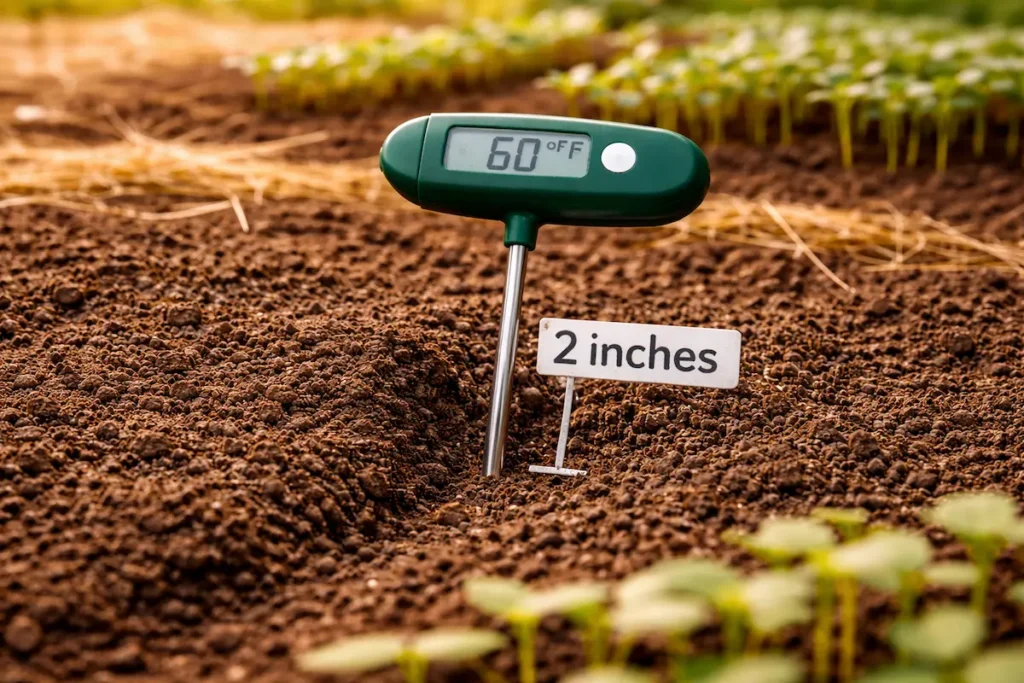
Insert a probe thermometer 2 inches deep at 9 a.m. — this captures the daily low before the sun warms the surface. Oregon State University Extension recommends taking readings at this time for 7 consecutive days and using the average as the planting decision point. A single warm afternoon does not mean the soil is ready. It is the sustained minimum that determines whether seeds germinate or rot.
Raised beds warm faster than in-ground plots — typically 5–10°F earlier in spring. Dark soil and south-facing slopes also gain heat sooner. Clear plastic sheeting laid over beds for 1–2 weeks before planting raises soil temperature by 8–12°F, a technique that can move planting forward by 2–3 weeks in Zones 5–6.
Cool-Season Crops: What to Sow Now (40–50°F Soil)
These crops germinate in cold soil and tolerate frost after emergence. In Zones 5–7, most of these are plantable from early to mid-March.
Peas — Minimum 40°F. Germination takes up to 5 weeks at 40°F but just 7–10 days at 60°F. Direct sow 1 inch deep as soon as soil is workable. Full guide in the March pea sowing article.
Spinach — Minimum 35°F. One of the most cold-tolerant seeds. Sow 1/2 inch deep. Germinates in 7–14 days at 45–55°F.
Lettuce — Minimum 35°F. Prefers cooler soil; germination actually declines above 75°F. Sow 1/4 inch deep or surface-sow and press into soil.
Radish — Minimum 40°F. Fastest germinating vegetable — 4–6 days at 55–65°F. Sow 1/2 inch deep.
Carrots — Minimum 40°F. Slow and erratic: 14–21 days at 50°F. Keep soil surface consistently moist during the long germination window or seeds fail.
Beets — Minimum 40°F. Each “seed” is a cluster of 2–4 seeds, so thinning is always required. Sow 1/2 inch deep, 8–12 days to germinate at 55°F.
Onion sets — Minimum 35°F. Plant 1 inch deep as soon as ground is workable.
Warm-Season Crops: When to Wait (60–85°F Soil)
These seeds rot in cold soil. Do not direct sow until soil temperature is reliably at or above the minimum — typically late May in Zones 5–6, mid-April in Zone 7.
Beans — Minimum 60°F. Optimum 80°F. Direct sow 1–1.5 inches deep. At 60°F, germination takes 14+ days; at 80°F, 5–7 days.
Corn — Minimum 60°F. Optimum 85°F. Sow 1.5–2 inches deep. Cold, wet soil causes rapid seed rot.
Cucumbers — Minimum 60°F. Optimum 85°F. Direct sow or transplant after soil consistently exceeds 65°F.
Squash/Pumpkins — Minimum 60°F. Optimum 85°F. Large seeds handle direct sowing well but rot fast below 60°F.
Tomatoes — Minimum 50°F for germination, but growth stalls below 60°F soil. According to UC Davis research, tomato seeds germinate in 6–8 days at 65–85°F but take over 40 days at 50°F. This is why tomatoes are started indoors and transplanted — not direct sown — in Zones 5–7. Full indoor timing in the March tomato and pepper guide.
Peppers — Minimum 60°F. Optimum 80–85°F. Even slower than tomatoes. Always start indoors 8–10 weeks before transplant.
What NOT to Do
❌ Trusting air temperature instead of soil temperature — A 65°F afternoon in March does not mean 65°F soil. Soil lags behind air temperature by 2–4 weeks. Measure directly.
❌ Planting warm-season seeds in cold soil “to get ahead” — Bean, corn, and squash seeds planted in 50°F soil do not germinate early. They sit, absorb moisture, and rot. The result is replanting in June — weeks behind schedule.
❌ Measuring soil temperature once and deciding — A single reading at noon on a sunny day overstates actual conditions. Measure at 9 a.m., 2 inches deep, for a full week.
This Week (March 10–16)
- Purchase a probe thermometer if not already owned
- Begin daily 9 a.m. soil temperature readings at 2-inch depth
- Sow cool-season crops (peas, spinach, radish, lettuce) if 7-day average exceeds 40°F
- Hold all warm-season seeds until soil reliably exceeds 60°F
By April 10
- Reassess soil temperature for beet and carrot sowing
- Lay clear plastic over beds intended for warm-season crops to accelerate warming
- Review compost reactivation timeline — finished compost applied as top-dress warms and feeds beds simultaneously.