
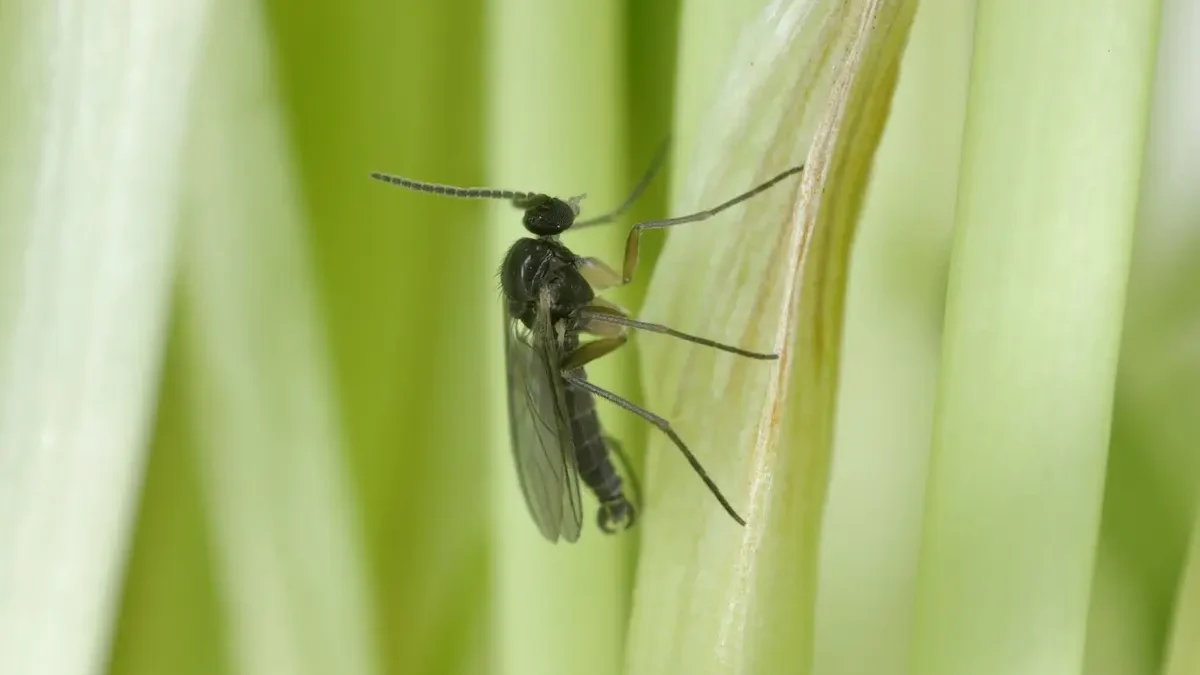
The small dark flies hovering over your seedling trays are not the problem. The problem is what they left in your potting mix three weeks ago. According to UC IPM, adult fungus gnats don’t damage plants — their larvae do. And by the time you notice adults flying around, a generation of white, translucent larvae is already feeding on roots in the top 2 inches of your seed-starting mix. In seedling trays in mid-March, that damage happens silently — plants wilt, yellow, or stall, and the cause looks exactly like overwatering.
The short answer:
- Adult gnats = nuisance only; larvae = root damage that mimics overwatering or nutrient deficiency
- Larvae live in the top 2 inches of potting mix and feed on root hairs and fine roots
- One generation completes in 17 days at 75°F — populations double fast in warm indoor grow spaces
- The fix is cultural first: let the top inch dry between waterings and the population collapses within two cycles
What’s Actually Happening in the Tray
Fungus gnat females lay up to 200 eggs in moist organic potting mix — peat and bark-based mixes are especially attractive. Eggs hatch in 3 days. Larvae feed for 10–14 days, pupate, and adults emerge 3 days later. At typical indoor temperatures of 68–75°F, Purdue Extension documents the full cycle completing in about 17 days — meaning a small infestation in early March becomes a large one by the end of the month.
The larvae themselves are easy to miss — transparent with a shiny black head capsule, about ¼ inch long, living in the top 1–2 inches of media. They feed primarily on fungi and organic matter, but when populations grow, they move to fine root hairs and root tissue. In seedlings, that’s the entire root system.
The secondary damage compounds the feeding. Clemson Extension documents that larval feeding wounds allow entry of Pythium, Fusarium, and Thielaviopsis. Adults carry fungal spores between trays. If seedlings are showing damping off alongside gnat activity, the gnats are likely spreading it.
How to Confirm Larvae Before Damage Appears
By the time seedlings wilt or yellow, root damage is already significant. Scout earlier with two methods.
Yellow sticky cards laid horizontally at soil surface — not vertically on stakes — capture far more adults, according to Michigan State University Extension. More than 5–6 adults per card per week indicates a population worth treating.
Potato wedge test. Press a raw potato slice flesh-side down onto the potting mix surface. Check after 48 hours — larvae are visible on the underside, translucent with a black head capsule. This confirms larval presence before root damage appears.
Three Controls That Actually Work
1. Dry the top inch — this is the most effective intervention
Fungus gnat larvae cannot survive in dry conditions. UC IPM identifies overwatering as the primary driver of infestation — moist soil provides both the conditions larvae need and the fungal growth they feed on. Allow the top inch of potting mix to dry completely between waterings. For seedlings past the cotyledon stage, this does not cause stress — roots extend below the top inch where moisture remains. One dry cycle kills the surface larvae. Two dry cycles collapse the population.
Bottom watering — trays in shallow water for 20 minutes, then drained — keeps the surface dry while roots absorb moisture from below. This is the single most effective change for seedling trays.
2. Bacillus thuringiensis israelensis (Bti) soil drench
Bti is a naturally occurring soil bacterium that kills fungus gnat larvae specifically and is safe for seedlings, people, and beneficial insects. Sold as Gnatrol or in mosquito dunk products, it is applied as a soil drench — water it in to reach the top 2 inches where larvae feed. UC IPM lists it as organically acceptable. Apply every 5–7 days for two cycles to break the larval generation.
3. Steinernema feltiae nematodes
Beneficial nematodes of this species actively hunt larvae in the potting mix. Apply as a soil drench to moist — not wet — media, out of direct sunlight. They need live hosts to persist, so reapply each generation cycle. Clemson Extension documents them as effective at low populations before larvae reach damaging levels.
What Not to Do
❌ Treating adults with sprays and ignoring the larvae — pyrethrins knock down adults quickly but do nothing to the larvae already in the soil. The next generation emerges within days. Adult control without larval control is temporary at best.
❌ Letting seedling trays sit in standing water in drainage saucers — standing water in saucers is the fastest way to sustain a fungus gnat population. Roots absorb it, surface stays wet, and larvae thrive. Empty saucers within 30 minutes of watering.
❌ Adding hydrogen peroxide drench without fixing the watering — H2O2 kills larvae on contact but does not persist in soil. If the surface stays moist, the next generation hatches into the same conditions. Fix the watering first.
This Week and Next 30 Days
This week — March 19–25:
- Press a potato wedge onto the surface of any tray where adults are visible — check after 48 hours
- Switch all trays to bottom watering immediately — remove from saucers after 20 minutes
- Place yellow sticky cards horizontally at soil level in trays showing adult activity
- If larvae are confirmed: apply Bti drench this week
By April 19:
- Apply a second Bti drench 5–7 days after the first to catch the next larval cycle
- If seedlings show unexplained wilting or yellowing despite correct watering, check roots for blunt, damaged tips — the sign of larval feeding
- Any tray with severe root damage: remove affected seedlings, replace potting mix, treat remaining plants before moving to a clean tray
Also read:
- Hardening Off Seedlings: The 7-Day Method That Prevents Transplant Shock
- Seed Starting Indoors: How to Grow Strong Seedlings Before Spring
- Direct Sowing Peas in March: Zone-by-Zone Timing Before They Bolt
- Container Gardening: Grow Fresh Vegetables on a Balcony or Patio
- Purple Tomato Seedlings in March: 3 Causes and How to Fix Each One