
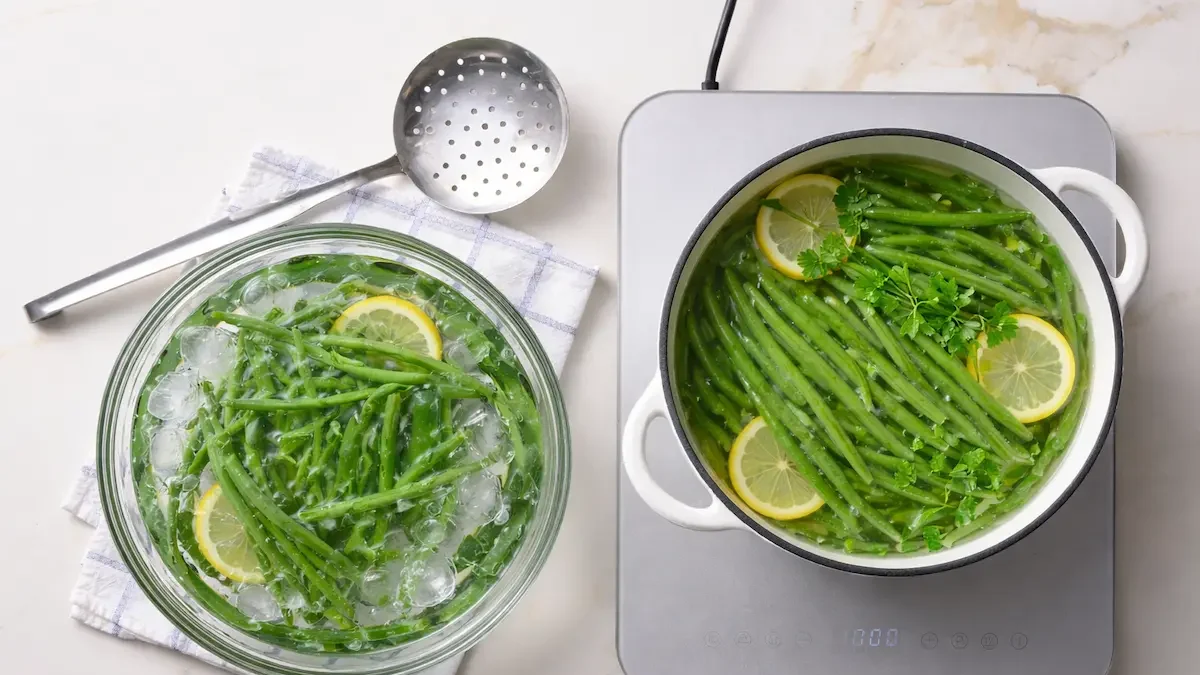
Mushy frozen vegetables are not caused by freezing itself. They are caused by two specific errors: underblanching, which leaves enzymes active to break down cell structure during storage, and slow freezing, which forms large ice crystals that physically rupture the cell walls. Both are avoidable.
Quick Answer
Why blanch at all: blanching stops enzyme activity that degrades flavour, colour, and texture during frozen storage. Enzymes are not killed by freezing — only by heat. Without blanching, vegetables deteriorate in the freezer within weeks.
The two rules for texture: follow blanching times exactly (under-blanching is worse than none), and freeze as quickly as possible after packing. Rapid freezing creates small ice crystals; slow freezing creates large ones that rupture cell walls and produce mushiness on thawing.
Crops that do not need blanching: tomatoes, peppers, onions, fresh herbs, and spring onions can be frozen without blanching. Their use in cooked dishes means texture loss from enzyme activity is less noticeable.
According to the National Center for Home Food Preservation, blanching is a must for almost all vegetables to be frozen — it stops the enzyme actions that cause loss of flavour, colour, and texture during storage. Blanching time is crucial and varies with the vegetable and size. Underblanching stimulates enzyme activity and is worse than no blanching: as the vegetable heats, enzymes temporarily become more active before being deactivated. If heat is insufficient to fully stop them, they continue working through the freeze. Overblanching causes loss of flavour, colour, and vitamins, and produces a pre-cooked texture before the vegetable is ever frozen.
Why Ice Crystal Size Determines Texture
USDA Food Safety and Inspection Service explains the mechanism: rapid freezing prevents large ice crystals from forming because water molecules do not have time to arrange into extended crystal structures. Slow freezing allows large crystals to develop that physically puncture plant cell walls, and when the cell wall ruptures, the vegetable loses structural integrity on thawing — producing the soft, waterlogged texture that makes frozen vegetables unpleasant. Do not overload the freezer: no more than 2–3 pounds per cubic foot per 24 hours. Set to its coldest setting several hours before loading, and spread packages in a single layer.
Blanching Times for Common Homegrown Crops
| Vegetable | Preparation | Water Blanch Time | Notes |
|---|---|---|---|
| Peas (shelled) | Shell, wash | 1½ minutes | One of the most successful freezing crops. Cool in ice water for the same time as blanching |
| Broad beans | Shell; remove inner skin if preferred | 3 minutes | Skin toughens in freezer — remove after blanching for better texture |
| French beans, runner beans | Top and tail; cut to even lengths | 2–3 minutes | Smaller pieces: 2 min. Larger: 3 min. Uniform size essential for even blanching |
| Courgettes | Slice to ½ inch; do not peel | 3 minutes | Texture softens — best used in cooked dishes after freezing |
| Spinach, kale, chard | Remove woody stems; wash thoroughly | 2 minutes | Use 2 gallons water per pound of leafy greens. Squeeze out water fully before packing |
| Broccoli, calabrese | Cut into 1–1½ inch florets | 3 minutes | Add 1 tsp salt per gallon of blanching water to drive out any insects |
| Carrots | Peel, slice or dice evenly | 2 min (sliced); 5 min (whole small) | Cool completely before packing. Uneven pieces produce uneven texture |
| Beetroot | Cook fully before freezing — do not blanch raw | Cook until tender: 25–50 min by size | Must be fully cooked, cooled, and peeled before freezing — blanching alone is not sufficient |
What to Do
- Use 1 gallon of water per pound of vegetables— insufficient volume means temperature drops when vegetables are added and does not return to a full boil within 1 minute. Start timing only when the water returns to a rolling boil
- Cool in ice water for the same time as blanching—Alaska Cooperative Extensionis explicit: cooling time should equal blanching time. Under-cooling means residual heat continues cooking the vegetable after it leaves the water
- Dry thoroughly before packing— surface moisture causes clumping and ice build-up. Drain in a single layer on a towel and allow to air-dry
- Tray-freeze before bagging— spread blanched, dried vegetables on a tray and freeze until firm (1–2 hours), then transfer to bags. This prevents clumping and allows partial use
- Label with crop and date— best used within 12 months; quality declines gradually after that though food remains safe
Common Mistakes
- Underblanching to preserve crunch— shorter blanching time does not preserve texture; it leaves enzymes active and results in worse texture after a few weeks in the freezer, not better
- Microwave blanching—NCHFP statesmicrowave blanching may not effectively inactivate all enzymes and is not recommended for home preservation
- Overloading the freezer when loading— too much unfrozen food raises the freezer temperature and slows the freeze, forming large ice crystals throughout the batch. Load no more than 2–3 pounds per cubic foot per 24 hours
- Freezing raw beetroot— raw beetroot does not respond to standard blanching. It must be fully cooked, cooled, and peeled before freezing
The Process
- Prepare and cut to uniform size before blanching
- Bring water to a rolling boil — 1 gallon per pound
- Start timing when water returns to the boil
- Cool in ice water for same time as blanching
Before Packing
- Drain and dry thoroughly in a single layer
- Tray-freeze before bagging for loose pack
- Remove as much air as possible from bags
- Label with crop, variety, and date — use within 12 months