
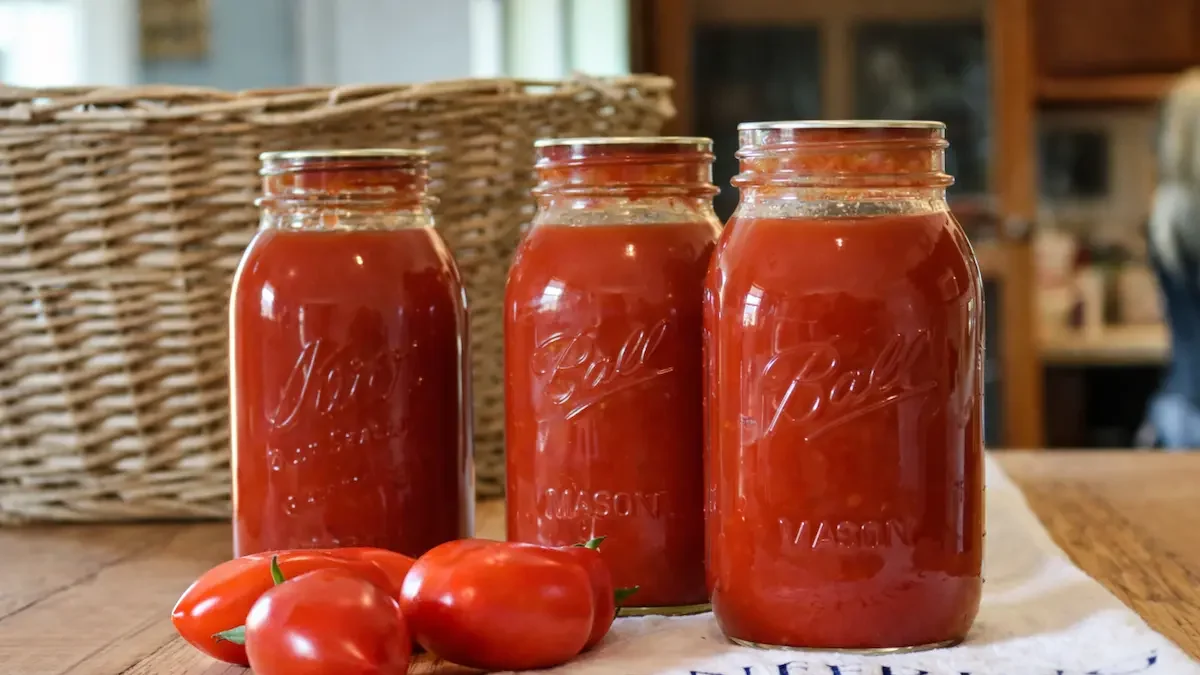
Tomatoes are one of the easiest crops to preserve, but they sit right on the edge of food safety. Unlike high-acid fruits, they require a little care to store safely without a pressure canner. The key is simple: acidify, heat properly, and seal correctly.
Done right, bottled tomatoes will keep for a year or more and become one of the most useful staples in your kitchen.
The Safety Principle You Need to Understand
Tomatoes are naturally acidic, but not always acidic enough to safely water-bath can on their own.
That’s why acid must be added.
According to USDA home canning guidelines, adding lemon juice or citric acid ensures tomatoes are safely preserved in a boiling water bath rather than requiring pressure canning.
This is the step that makes the entire process safe.
What You Need
You don’t need specialist equipment:
- Large pot (deep enough to cover jars with water)
- Glass jars with lids
- Tomatoes (any variety)
- Lemon juice or citric acid
- Optional: salt
This is basic water-bath canning — simple and accessible.
Step 1: Prepare the Tomatoes
Use ripe, healthy tomatoes. Overripe is fine, but avoid spoiled fruit.
To peel easily:
- Score a small cross on the bottom
- Dip in boiling water for 30–60 seconds
- Transfer to cold water
- Skins will slip off
Remove cores and cut if needed.
Peeling improves texture and storage quality, though it’s technically optional.
Step 2: Add Acid to Each Jar
This is the non-negotiable step.
Per litre (quart) jar:
- 2 tablespoons bottled lemon juice
or - ½ teaspoon citric acid
Add this directly to the jar before filling.
Do not rely on the natural acidity of tomatoes alone.
Step 3: Fill the Jars
You can pack tomatoes two ways:
Raw pack:
- Fill jars tightly with prepared tomatoes
- Press down to release juice
Hot pack:
- Simmer tomatoes for 5 minutes first
- Then fill jars with hot tomatoes and juice
Hot packing reduces air and improves shelf life, but both methods work.
Leave about 1–2 cm headspace at the top.
Step 4: Seal the Jars
Wipe the rims clean — this is critical for a proper seal.
Apply lids and screw bands until fingertip tight.
Do not overtighten — air needs to escape during processing.
Step 5: Water Bath Processing
Place jars in a large pot of boiling water.
Water must cover jars by at least 2–3 cm.
Process:
- 35–45 minutes for pints
- 40–50 minutes for quarts
Timing depends slightly on altitude, but this is the general range.
According to National Center for Home Food Preservation tomato canning guide, full processing time is essential to destroy spoilage organisms and ensure a safe seal.
Step 6: Cooling and Checking
Remove jars and let them cool undisturbed for 12–24 hours.
You’ll hear lids “pop” as they seal.
Check seals:
- Lid should not flex when pressed
- If it does, refrigerate and use soon
Store sealed jars in a cool, dark place.
What You End Up With
The result is preserved tomatoes in their own juice — ready to use for:
- Sauces
- Soups
- Stews
- Winter cooking
They’re far more versatile than frozen tomatoes and take up no freezer space.
Common Mistakes
Skipping added acid — the biggest safety risk
Overfilling jars — prevents proper sealing
Not processing long enough — leads to spoilage
Using damaged jars — increases failure rate
Tightening lids too much — traps air inside
Most failures come down to one of these issues.
A More Practical Way to Think About It
You’re not just storing tomatoes — you’re creating a stable, shelf-safe environment.
Heat kills organisms. Acid prevents dangerous ones from growing. Sealing keeps everything stable.
Once you understand that, the method becomes straightforward.
Raw vs Hot Pack — Which Is Better?
Raw pack is faster and works well for large batches.
Hot pack:
- Reduces floating
- Improves texture
- Gives better long-term quality
If you’re aiming for consistency, hot pack is usually worth the extra step.
How Long They Last
Properly processed jars:
- Safe for 12+ months
- Best quality within a year
After that, they’re usually still safe but lose flavour.
Long-Term Perspective
Once you start bottling tomatoes, it becomes a core part of your harvest routine.
Instead of dealing with gluts all at once, you turn them into a stable food supply that carries you through winter.
It’s one of the most efficient ways to preserve a garden crop — simple, repeatable, and highly practical.
If you want, I can do the next one: how to make passata properly or how to sun-dry tomatoes at home.