
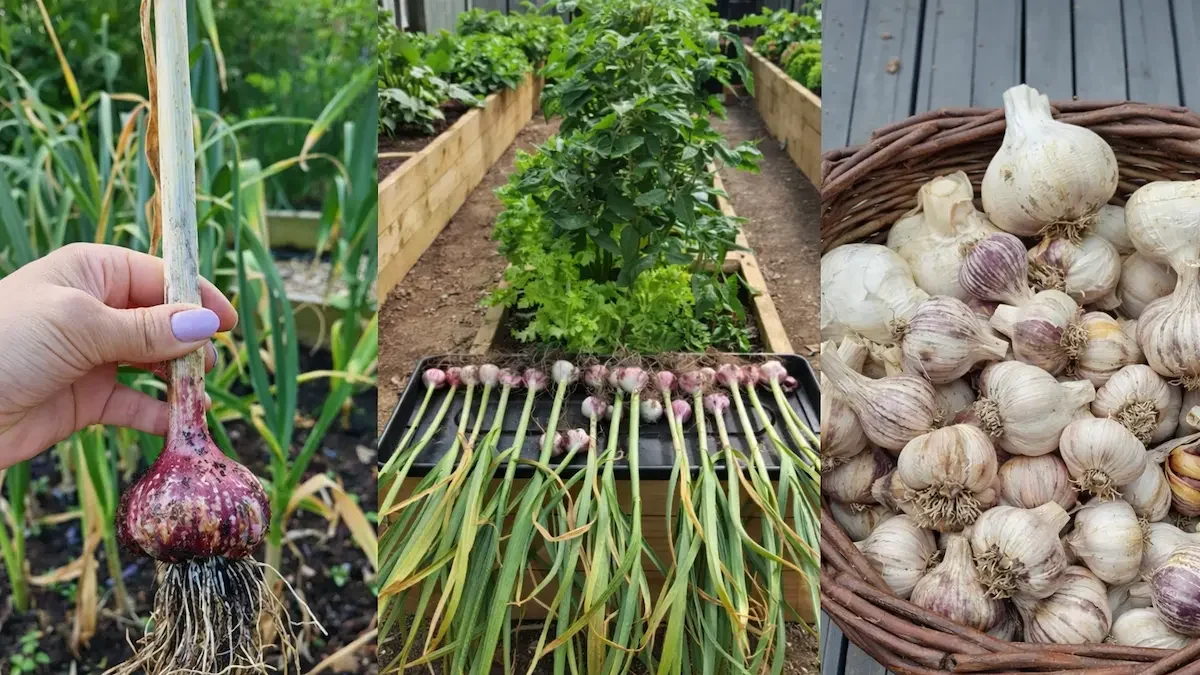
Garlic is one of the lowest-maintenance crops in the kitchen garden. Plant in autumn, mulch, remove the scape in early summer, stop watering two weeks before harvest. Most failures trace back to two errors: planting at the wrong soil temperature, and leaving the scape on. The second costs up to half the harvest.
Quick Answer
When to plant in the UK: mid-October to mid-November — after the first frosts but before the ground freezes. Soil temperature at 5cm should be around 10°C (50°F). Too early means too much tender top growth before winter; too late means insufficient root development.
Hardneck or softneck? Hardneck varieties produce edible scapes, have richer flavour, and store for 3–6 months. Softneck varieties store for 9–12 months and suit milder winters where hardnecks may not receive enough cold to form proper cloves.
The single most important in-season task: remove the scape in early June, at the first curl. University of Maine research found that leaving the scape on reduces harvested bulb size by up to 48 percent.
According to University of Minnesota Extension’s garlic growing guide, garlic performs best in well-drained, moisture-retentive soil with a pH between 6.0 and 7.0. It has a moderate to high nitrogen demand — incorporate well-rotted compost before planting, apply a nitrogen top-dressing at shoot emergence in spring, then again two to three weeks later. University of Maine Cooperative Extension (Bulletin 2063, revised 2025) is explicit that later nitrogen applications are counterproductive: they do not increase yield and reduce storage life of harvested bulbs.
Hardneck vs Softneck — Which to Choose
| Type | Flavour | Cloves per Bulb | Storage | Scape? | Best For |
|---|---|---|---|---|---|
| Hardneck | Complex, often hot or nutty by variety | 4–8, large and easy to peel | 3–6 months | Yes — remove it | Cold climates, flavour, fresh use |
| Softneck | Milder, more uniform | 10–20, smaller | 9–12 months | No | Long storage, milder regions, braiding |
Planting and Feeding
Separate bulbs into cloves no more than 24 hours before planting. Plant pointed tip upward and flat base down at 5–7cm (2–3 inches) deep, in rows 25cm (10 inches) apart with cloves 15cm (6 inches) apart within the row. Mulch immediately with 5–8cm of straw — this suppresses weeds, retains moisture, and protects roots from hard frosts. SDSU Extension notes that garlic shoots tolerate air temperatures down to -7°C (20°F) without damage; temperatures below -12°C (10°F) may cause dieback. In spring, draw the straw back to allow shoots to emerge, then replace it around the plants to reduce weeding.
The Scape — Remove It Early
Hardneck garlic produces a scape in early June — a curling flower stalk from the centre of the plant. University of Maine research found that leaving the scape on reduces harvested bulb size by as much as 48 percent. Remove it when it has formed its first curl and the thickened bulbil body is just visible — at this stage it is tender enough to cook (use it like a mild spring onion or make scape pesto). Removing the scape early rather than waiting until it curls a second time still reduces bulb size by 9 percent, so timing genuinely matters.
Harvest and Curing
| Stage | UK Timing | What to Do |
|---|---|---|
| Planting | Mid-Oct to mid-Nov | Cloves 5–7cm deep, 15cm apart, rows 25cm; mulch with straw immediately |
| Spring top-dressing | February–March | Nitrogen at shoot emergence; second feed 2–3 weeks later; no more after this |
| Scape removal | Early June | Cut at first curl; eat fresh — scapes do not store well |
| Stop watering | 2 weeks before harvest | Allows outer wrappers to dry; reduces storage rots |
| Harvest | Late June–late July | When 3 lower leaves are brown and roughly half the upper leaves remain green; use a fork — do not pull straight up |
| Curing | 3–4 weeks post-harvest | Hang in bundles of 10 in dry, airy shade; good air movement; not in direct sun |
| Storage | After curing | Trim stems to 3–4cm; store at 15–18°C in mesh bags; never refrigerate |
What to Do
- Buy from a UK seed supplier, not supermarket bulbs— imported supermarket garlic may carry virus strains not present in UK stock and is often unsuited to UK conditions
- Remove the scape at the first curl in early June— this is the highest-value single task of the growing season; delay costs yield, not effort
- Stop watering two weeks before harvest— this prevents wrapper staining and reduces storage disease risk
- Harvest when 3 lower leaves are brown, half the upper leaves still green— too early means poorly-wrapped bulbs; too late means cloves burst out of their skins
- Save your largest bulbs for replanting each year— selecting the biggest over several seasons adapts your garlic strain to your soil and climate
Common Mistakes
- Leaving the scape on— University of Maine research quantified the yield loss at up to 48 percent of bulb size; there is no reason to leave it on
- Planting in wet, poorly-drained soil— garlic is highly susceptible to white rot and basal rot in waterlogged conditions; raised beds or well-worked free-draining soil are essential
- Refrigerating cured garlic— cool moist conditions promote sprouting; store at 15–18°C in a dry, airy location; never in a sealed bag or refrigerator
- Applying nitrogen after the second spring feed— later applications reduce storage life without increasing yield, per University of Maine Extension
At Planting
- Soil temp ~10°C at 5cm before planting
- Pointed end up, flat base down, 5–7cm deep
- Mulch immediately with 5–8cm straw
- Hardneck for flavour; softneck for long storage
Through the Season
- Two nitrogen feeds in spring — emergence then 3 weeks later
- Remove scape at first curl in early June
- Stop watering 2 weeks before harvest
- Cure 3–4 weeks in dry, airy shade before storing