
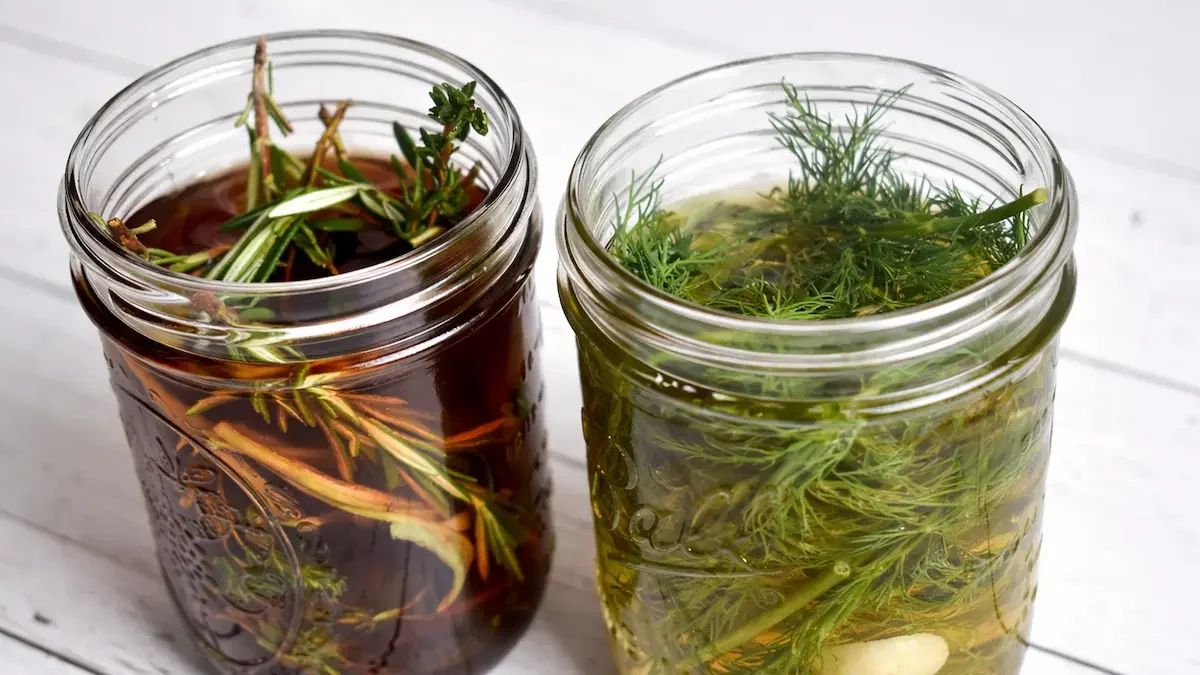
Herb vinegar is straightforward and safe to make at home. Herb oil with fresh herbs is not — unless the fresh ingredients are first acidified, because fresh herbs in oil create conditions where botulism can develop. The simplest safe approach for herb oil is to use dried herbs rather than fresh.
Quick Answer
Herb vinegar: heat vinegar to 190°F (88°C), pour over fresh or dried herbs in a sterilised jar, seal, and leave for 2–4 weeks. Safe at room temperature for 2–3 months; refrigerated for up to 6–8 months. No safety concerns — vinegar is acidic enough to prevent bacterial growth.
Herb oil with dried herbs: heat oil to 180°F (82°C), pour over dried herbs in a sterilised jar, cool, seal. Refrigerate and use within 3 months. Safe because dried herbs contain no moisture, which is required for bacterial growth.
Herb oil with fresh herbs: do not make this at room temperature without acidifying the fresh herbs first. Fresh herbs in oil create a low-acid, oxygen-free environment where Clostridium botulinum can produce toxin. If you want to use fresh herbs, follow the University of Idaho citric acid method below, or use within 4 days from the fridge.
According to University of Maine Cooperative Extension (Bulletin 4385), the primary concern with infused oils is Clostridium botulinum. Fresh herbs and garlic can carry its spores, and oil creates the oxygen-free environment needed to produce toxin. Dried herbs contain no moisture — and since the bacterium requires water to grow — oils made with properly dried ingredients and refrigerated are safe when used within three months. University of Maine Extension is direct: the safest way to make flavoured oils at home is with dried ingredients.
The Two Safe Methods
Herb Oil — Dried Herb Method
Sterilise a glass jar by boiling for 10 minutes. Add dried herbs of your choice — rosemary, thyme, oregano, and bay all work well. Heat a good-quality oil (olive, rapeseed) to 180°F in a pan. Pour over the dried herbs, cap, and cool. Refrigerate immediately once cool.
Keeps in the fridge for up to 3 months. Discard after this time regardless of appearance.
Herb Vinegar — Fresh or Dried Herbs
Sterilise a glass jar or bottle. Add washed, dried fresh herbs or dried herbs. Heat white wine vinegar, cider vinegar, or white vinegar (4–5% acidity) to 190°F — do not boil. Pour over herbs, fill to within ¼ inch of the top, seal. Leave in a cool dark place for 2–4 weeks, tasting periodically.
Keeps at room temperature 2–3 months; refrigerated 6–8 months. If the vinegar becomes cloudy, slimy, or bubbles: discard.
Herbs and Combinations That Work Well
| Herb or Combination | Best Use | Oil or Vinegar | Notes |
|---|---|---|---|
| Rosemary + garlic (dried) | Bread dipping, roasting, pasta | Oil | Use dried garlic granules — never fresh garlic in oil without acidification |
| Thyme + bay (dried) | Roast vegetables, soups, marinades | Oil | Remove bay leaves after 2 weeks to prevent the flavour from becoming bitter |
| Tarragon + chive (fresh) | Salad dressings, cold sauces | Vinegar | Classic French combination; white wine vinegar gives the cleanest flavour |
| Basil + chilli (fresh) | Dressings, marinades, drizzling | Vinegar | Strain after 2 weeks for a cleaner appearance and balanced heat |
| Rosemary + lemon zest | Fish, poultry, roasted potatoes | Vinegar | Lemon zest becomes dominant after 3+ weeks — taste and strain early |
| Mixed garden herbs (dried) | General cooking oil | Oil | Practical way to preserve an end-of-season herb blend |
Fresh Herb Oil — If You Want to Do It Safely
Penn State Extension and UGA CAES Field Report (October 2025) describe the University of Idaho acidification method for garlic, basil, oregano, and rosemary. Soak herbs in a 3% citric acid solution — 1 tablespoon citric acid dissolved in 2 cups of water — for 24 hours with herbs fully submerged. The ratio is critical: 1 part leafy herbs to 10 parts solution; 1 part garlic to 3 parts solution. This brings the pH to 4.2 or below, preventing botulinum growth. Do not substitute vinegar or lemon juice for citric acid — they have not been tested and cannot be confirmed to reliably reach the required pH. Once acidified, herbs can be added to oil and stored at room temperature, though refrigeration improves quality.
Safety Rules — Do Not Skip These
- Never store fresh herb oil at room temperature without acidification— fresh garlic in oil has been linked to botulism cases in the US and Canada. Refrigerate immediately and use within 4 days, or follow the citric acid method above
- Discard oil after 3 months regardless of appearance—University of Maine Extensionnotes that rancid oil does not look or smell different from fresh oil
- Do not substitute lemon juice or vinegar for citric acid in oil— the acidification must reach pH 4.2 or below. Vinegar and lemon juice have not been tested at the ratios required for infused oil
- Discard vinegar that becomes bubbly, cloudy, or slimy— signs of fermentation or microbial growth. Discard without tasting
Making Herb Vinegar
- Sterilise jar by boiling 10 minutes
- Heat vinegar to 190°F — do not boil
- Pour over herbs, fill to within ¼ inch of top, seal
- Store in a cool dark place; taste after 2 weeks
Making Dried Herb Oil
- Sterilise jar by boiling 10 minutes
- Heat oil to 180°F; pour over dried herbs
- Cool, seal, refrigerate immediately
- Use within 3 months; label with the date