
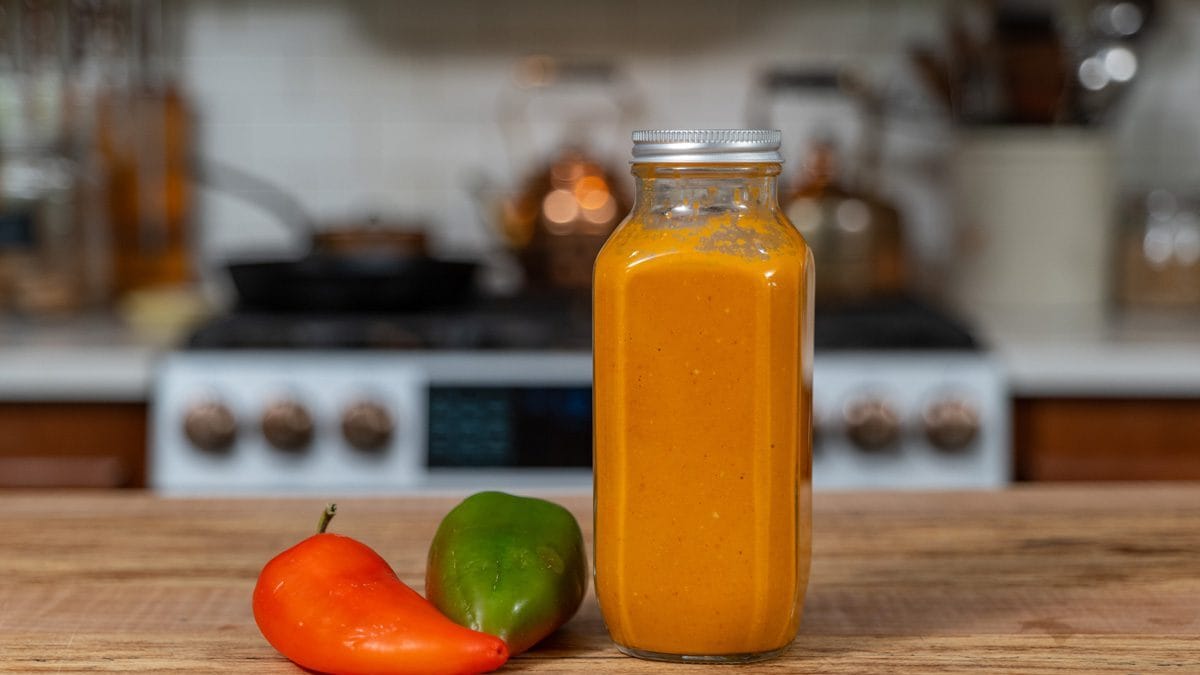
Fermented hot sauce is preserved by lactic acid, not vinegar. The result is a sauce with more depth, less sharp acidity, and a longer shelf life than anything you can buy. Two numbers govern the whole process: the salt percentage going in, and the pH coming out.
Quick Answer
Salt ratio: 2–3% of the combined weight of chillies and water. For every 1kg of chillies and water together, use 20–30g of non-iodised salt. Too little salt allows harmful bacteria to compete with Lactobacillus; too much suppresses all fermentation. Do not use iodised table salt — iodine kills the bacteria you need.
Safe pH for finished sauce: 4.0 or below before storing at room temperature. Salamander Sauce Company’s December 2025 guide is explicit: every fermented hot sauce requires final pH testing and adjustment to 4.0 or below for safe storage. Refrigerator storage is safe at a higher pH — up to about pH 4.6 — but room-temperature shelf storage requires the lower threshold.
The typical fermentation timeline: 7–14 days at 18–21°C (65–72°F) for a balanced, tangy sauce. Shorter ferments are less sour; longer ferments develop more complex, funky flavour.
According to Salamander Sauce Company’s fermentation guide (December 2025), the lacto-fermentation of chillies works through a predictable and well-understood process: salt creates osmotic pressure that inhibits pathogenic bacteria while allowing naturally present Lactobacillus strains to thrive. The bacteria convert sugars in the chillies to lactic acid, dropping the pH of the brine from around 6.5 at the start to 3.4–3.8 in a completed ferment. This acidification is what preserves the sauce — the same mechanism that preserves sauerkraut and kimchi. The salt concentration must sit between 2 and 3 percent of the total weight of the ferment to support this process safely.
What You Need
| Item | Notes |
|---|---|
| Chillies — any variety | Mix hot and mild for a balanced sauce; remove stems, leave seeds in for more heat |
| Non-iodised salt | Sea salt, kosher salt, or canning salt; never iodised table salt — iodine inhibits Lactobacillus |
| Filtered or rested tap water | Heavy chlorination inhibits fermentation; leave tap water uncovered overnight to let chlorine dissipate if needed |
| Clean glass jar with loose lid or airlock | CO₂ produced during fermentation must escape; do not seal completely or pressure builds up |
| Something to keep chillies submerged | Any chillies above the brine line are exposed to air and will mould; use a smaller jar filled with brine as a weight |
| pH meter or strips (recommended) | Not essential for refrigerator storage; required if you intend to store the finished sauce at room temperature |
The Full Process
Weigh and prepare chillies
Remove stems; halve or roughly chop. Wear gloves — capsaicin does not wash off easily. Add aromatics if desired: garlic cloves, a few slices of onion, or a carrot to add sweetness. Weigh the chillies and note the weight — you need this for the salt calculation.
Make the brine
Weigh the water you will use to fill the jar. Add the chilli weight and the water weight together. Calculate 2.5% of that total — this is the amount of non-iodised salt to add. Example: 500g chillies + 500ml water = 1,000g total; use 25g salt. Dissolve salt in the water completely before adding to the jar.
Pack and submerge
Pack chillies firmly into the jar; pour brine over them. Every piece must be submerged below the brine — exposed chillies will develop mould. Place a weight on top. Loosely cover with a lid, cloth, or airlock to allow CO₂ to escape while keeping dust and insects out. Set somewhere at 18–21°C away from direct sunlight.
Ferment 7–14 days
Check daily. Signs of active fermentation: brine turns cloudy; small bubbles visible; brine may overflow (set jar on a plate). Cloudy brine is a good sign — it is lactic acid and yeast in suspension, not spoilage. Skim any white surface film (kahm yeast) if it appears; it is harmless but can add off-flavour. Taste from day 7 — stop when the flavour is right.
Blend and store
Strain the fermented chillies, reserving the brine. Blend chillies with enough brine to reach the desired consistency — smooth or chunky. Taste and adjust with a little extra salt or a splash of lime juice if needed. Refrigerate for up to one year. For room-temperature storage, check pH is at or below 4.0 first.
What to Do
- Weigh everything and calculate salt by weight, not volume— tablespoon measurements are imprecise for fermentation; a kitchen scale and the 2.5% calculation produces a consistent, safe result every time
- Keep chillies fully submerged throughout fermentation— this is the single most important daily task; any piece above the brine line will mould within 24–48 hours
- Test pH before storing at room temperature— refrigerator storage is safe at pH up to 4.6; shelf storage requires pH 4.0 or below; if the pH has not fallen far enough, add a splash of distilled white vinegar and retest
- Use the reserved brine as the blending liquid— it contains the Lactobacillus cultures and developed flavour of the ferment; discarding it and blending with fresh water produces a flat, less complex sauce
Common Mistakes
- Using iodised table salt— iodine is added to salt to prevent thyroid deficiency in humans; it also inhibits the Lactobacillus bacteria you are relying on; use sea salt, kosher salt, or canning salt only
- Sealing the jar completely— lacto-fermentation produces CO₂; a sealed jar will either overflow or pressurise; always leave an escape route for gas
- Assuming the sauce is room-temperature stable without checking pH— a two-week ferment usually produces a pH well below 4.0, but not always; at warmer temperatures or with very fresh-picked chillies, fermentation may be slower; measure before committing to shelf storage
Day One
- Weigh chillies and water; calculate 2.5% salt
- Dissolve salt in water before adding to jar
- Submerge all pieces; cover loosely
- Place on a plate — brine may overflow
Days 7–14
- Taste from day 7 — stop when flavour is right
- Skim kahm yeast from surface if it appears
- Blend with reserved brine to desired consistency
- Check pH if storing at room temperature