
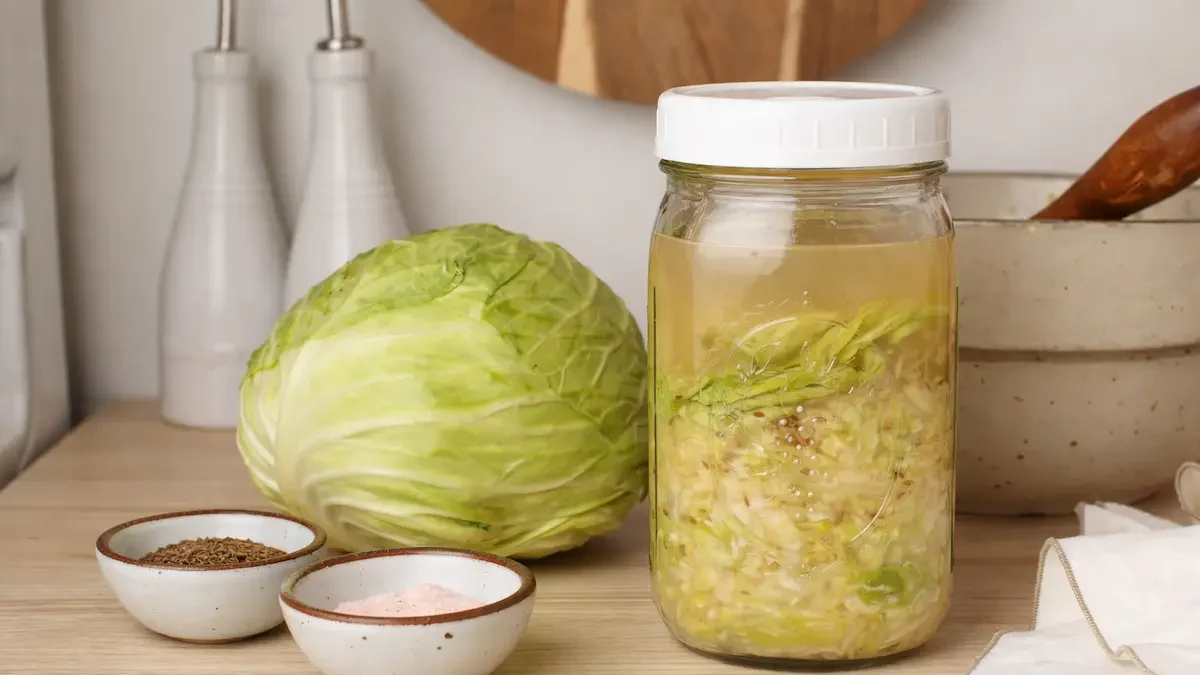
Sauerkraut is one of the simplest preservation methods available to a home grower. Two ingredients — cabbage and salt — ferment naturally over two to four weeks using bacteria already present on the cabbage leaves. The result is shelf-stable, probiotic-rich, and requires no canning equipment.
Quick Answer
The exact salt ratio: 3 tablespoons of canning or pickling salt per 5 pounds of shredded cabbage (approximately 2.25–2.5% salt by weight). Do not substitute iodised table salt — iodine interferes with fermentation. Do not change the ratio — too little salt softens the cabbage and allows pathogen growth; too much delays fermentation and causes off-flavours.
Temperature: 70–75°F (21–23°C) is ideal. Sauerkraut fully ferments in 3–4 weeks at this temperature. At 60–65°F, fermentation takes 5–6 weeks. Below 60°F it may not ferment at all. Above 80°F it will soften and spoil.
The single most important rule: the cabbage must remain fully submerged under brine throughout fermentation. Any cabbage above the brine line will develop mould and must be discarded.
According to Penn State Extension’s fermentation guide, the exact ratio of 3 tablespoons of canning or pickling salt to 5 pounds of shredded cabbage controls pathogen growth — and changing this proportion could result in an unsafe product. The mechanism is lacto-fermentation: Lactobacillus bacteria naturally present on cabbage leaves convert sugars to lactic acid in the absence of oxygen. Salt draws moisture from the cells to create the brine the bacteria need, while suppressing competing organisms. NCHFP recommends starting fermentation within 24–48 hours after harvest, using firm mid- to late-season cabbage. Summer varieties are less dense and produce less brine.
The Full Process
Prepare the cabbage
Remove outer leaves and rinse the head under cold water. Quarter, remove the core, and shred finely — aim for the thickness of a 25-cent coin (about 1/16 inch). Weigh the shredded cabbage before salting. Work in 5-pound batches.
Add salt and work until brine forms
Add 3 tablespoons of canning or pickling salt per 5 pounds. Mix thoroughly with clean hands. Pack firmly into the fermentation container, squeezing and pounding as you go — natural juices should rise above the surface. If brine does not form within 24 hours, add a cooled solution of 1½ tablespoons of salt dissolved in 1 quart of boiled water.
Keep cabbage submerged
Place a plate just small enough to fit inside the container on top of the cabbage and weight it down with jars of water. UMN Extension recommends an alternative: lay a sealed food-grade plastic bag filled with brine solution over the surface — it conforms to the container and keeps the surface fully sealed. Cover the top with a clean cloth.
Ferment at 70–75°F for 3–4 weeks
Keep away from direct sunlight. If using jar weights, check 2–3 times per week and remove any scum. Do not disturb if using the brine-bag method. Fermentation is complete when bubbling stops and the cabbage has turned from opaque white-green to translucent golden with a clean, distinctly sour smell.
Store or process
Transfer to clean jars with enough brine to keep the kraut covered. Store in the fridge for several months, or freeze in sealed bags (texture changes slightly but flavour is retained). For shelf-stable storage, water-bath can in sterilised jars — note that canning kills the Lactobacillus bacteria and removes the probiotic benefit.
Troubleshooting
| Problem | Cause | Fix or Judgement |
|---|---|---|
| No brine forming after 24 hours | Salt has not fully drawn moisture out yet, or cabbage is too dry | Mix and pack more vigorously; add cooled brine solution (1½ tbsp salt per 1 quart water) |
| White scum on surface | Normal yeast activity — harmless kahm yeast | Skim off and discard; ensure cabbage remains submerged |
| Pink or discoloured kraut | Uneven salt distribution or excess salt; certain yeast growth | Discard if pink throughout; surface pink only — skim and check smell |
| Soft, mushy texture | Too little salt, too warm, or fermented too long | Soft but clean-smelling kraut is safe to eat; significantly soft with off-odour — discard |
| Dark or black kraut | Exposure to air, high fermentation temperature, or very long storage | Surface darkening only: remove top layer. Darkening throughout: discard |
Common Mistakes
- Using iodised table salt— iodine inhibits the Lactobacillus bacteria that drive fermentation. Use only canning salt, pickling salt, kosher salt, or non-iodised sea salt
- Changing the salt ratio— Penn State Extension and NCHFP are both explicit: altering the tested ratio can result in an unsafe product. Weigh the cabbage and measure salt precisely
- Not keeping cabbage submerged— any surface exposure to air allows mould. Check daily and ensure brine covers all surfaces
- Fermenting in a metal container—UMN Extensionis explicit: metal reacts with the lactic acid produced during fermentation. Use only glass, ceramic, or food-grade plastic
Day One
- Use firm mid- or late-season cabbage within 48 hours of harvest
- Weigh shredded cabbage; measure 3 tbsp salt per 5 lbs precisely
- Pack firmly; brine should cover surface within a few hours
- Weigh down, cover with cloth, place at 70–75°F
During Fermentation
- Check every 2–3 days if using jar weights; remove any scum
- Ensure brine level stays above the cabbage
- Taste after 2 weeks — ready when pleasantly sour
- Transfer to fridge when fermentation is complete (bubbling stops)