
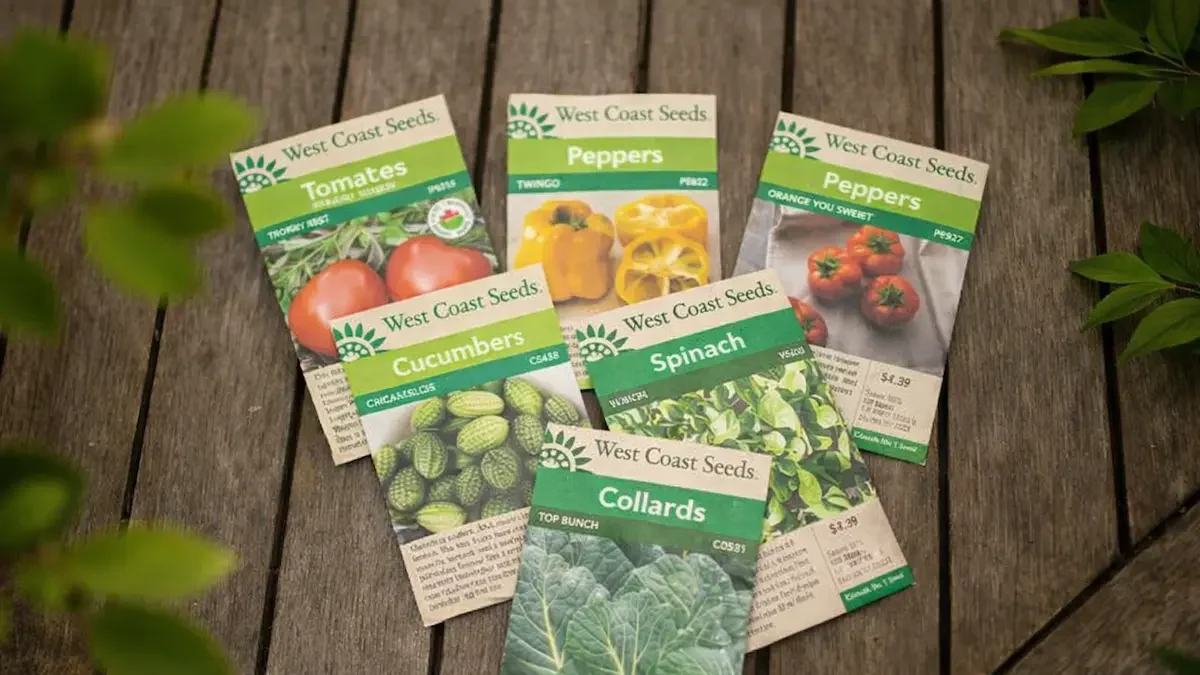
A seed packet contains eight distinct pieces of information. Most beginners use two — the picture on the front and a rough planting date. Here’s what every field actually means, which ones most growers misread, and why “days to maturity” is not as straightforward as it looks.
Quick Answer
Days to maturity — counts from germination for direct-sown crops, but from transplanting for crops started indoors. A tomato listed as “80 days” needs 80 days after going in the ground — add 6–8 weeks of indoor growing for the real total.
Row spacing vs plant spacing — row spacing is designed for machinery. For raised beds, ignore it and use plant spacing in all directions.
Germination rate % — a 75% rate means sow 20–30% more seeds than the number of plants you need, then thin.
According to Nebraska Extension’s NebGuide on seed packets, the germination rate tells you how many seeds will produce plants under ideal conditions — but the age of the seeds and how they have been stored will affect the actual result. This makes germination rate a starting point for calculating how many seeds to sow, not a guarantee. Cornell Garden-Based Learning identifies the main packet categories: sowing depth, plant spacing, when to plant, sunlight needs, and time to germination and harvest. Understanding all of them — not just the planting date — is what separates a successful sowing from a patchy one.
What Every Field on the Packet Actually Means
| Field | What It Means | Watch Out For |
|---|---|---|
| Days to maturity | Time from germination (direct-sown) or from transplanting (indoor-started) to first harvest | For tomatoes, peppers, aubergines — count from transplant date. Add 6–8 weeks for the indoor period when planning backwards from last frost |
| Days to germination | Days before first seedling emerges — under ideal conditions | Cool soil slows germination significantly. “7–14 days” may mean 21+ days in cold spring soil below the crop’s minimum threshold |
| Sowing depth | How deep to place the seed. Fine seeds need only a light cover; large seeds (peas, beans) need 1–2 inches | Some seeds require light to germinate — “surface sow” means press to the surface, do not cover |
| Plant spacing | How far apart each plant should be at maturity — use this for raised beds in all directions | Row spacing is for machinery access. Ignore row spacing for raised beds; use plant spacing in all directions |
| Germination rate % | Percentage of seeds expected to sprout under ideal conditions | 75% rate = 1 in 4 may not germinate. Sow 20–30% more than the number of plants you need, then thin |
| F1 / Open Pollinated / Heirloom | F1 = hybrid (vigorous, consistent, but seeds cannot be saved reliably). Open pollinated = saves true to type. Heirloom = open pollinated with historical provenance | F1 seeds do not come true from saved seed. If you save seeds, choose open-pollinated varieties |
| Sow indoors / direct sow from | Minimum safe sowing date, calculated backwards from expected last frost | Dates are generalised for a broad region. Use your local last frost date — adjust ±2–3 weeks for your zone |
| Packed for year / use-by | The year germination rate was tested. Viability declines with age | Test older seeds: 10 on damp kitchen paper, keep warm, count after the days-to-germination window. Discard if fewer than 5 of 10 sprout |
The most commonly misread number is days to maturity for indoor-started crops. Saratoga Associates’ guide explains: packets often don’t specify whether the count is from seed or from transplant. For tomatoes the number almost always means days from transplanting. A “75-day” tomato needs 75 days in the ground plus 6–8 weeks of indoor growing — total 130–140 days, not 75. Not knowing this is the most common reason gardeners are still waiting for ripe tomatoes in September.
✗ Common Seed Packet Mistakes
- Using row spacing for a raised bed— row spacing assumes machinery access. Use plant spacing in all directions for blocks and raised beds
- Counting days to maturity from sowing for tomatoes and peppers— count from transplant date. For these crops, total seed-to-harvest is typically 130–140 days, not the 70–80 days on the packet
- Ignoring germination rate— a 70% rate means sow more than you need, then thin. Don’t sow one seed per station and expect every one to produce a plant
- Using old seeds without testing— check the packed-for year; test older seeds on damp kitchen paper before committing a whole bed
✓ How to Use a Seed Packet Correctly
- Find your local last frost date— then count back using the “start indoors X weeks before last frost” figure. Use a local date, not a national average
- Use plant spacing for all raised beds— space equally in all directions in a diamond pattern
- Add indoor growing time for transplanted crops— for tomatoes, add the 6–8 weeks of indoor growing to the packet’s days-to-maturity for the real total
- Write sowing dates on the packet— tracking emergence against packet predictions calibrates your planning for next season
📅 Before You Sow
- Check packed-for year on every packet
- Note whether days-to-maturity is from seed or transplant
- Find your local last frost date
- Test seeds over 2 years old on damp kitchen paper
📆 When Sowing
- Use plant spacing for raised beds — not row spacing
- Sow 20–30% more if germination rate is below 85%
- Write the sowing date on the packet
- Mark emergence date — calibrates future planning