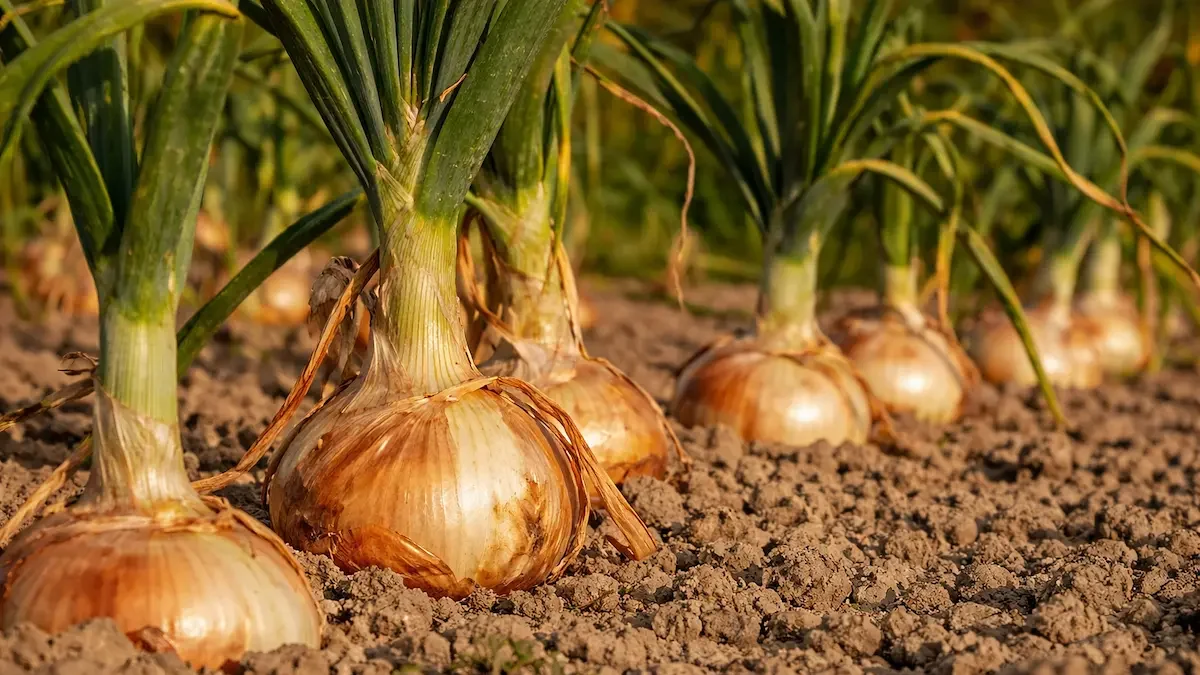
Onion sets go in the ground as soon as soil is workable — weeks before last frost. Early planting produces larger bulbs because onions need maximum leaf growth before lengthening days trigger bulbing.
Onion bulb size depends directly on how large the plant is when day length reaches the bulbing threshold — roughly 14 hours for long-day varieties grown in Zones 4–7. According to Oregon State University Extension, Jim Myers, Endowed Chair of Vegetable Breeding and Genetics, states that early planting is critical because larger plants at the start of bulbing produce larger bulbs at harvest. Every week of delay in March or April means less leaf growth before the plant shifts energy into the bulb. Iowa State University Extension confirms that onion sets planted after mid-May produce undersized bulbs or fail to bulb entirely because hot summer temperatures trigger bulb formation before the plant has enough foliage to support a full-sized onion.
The short answer:
- Plant sets as soon as soil is workable — late March in Zones 6–7, early to mid-April in Zones 4–5
- Push sets 1–1.5 inches deep, pointed tip facing up
- Space 3–4 inches apart for bulb onions, 1 inch apart for green onions
- Sort sets by size before planting: smaller than a nickel = bulb onions, larger = green onions only
Why Sets Over Seed
Onion sets are small dormant bulbs grown the previous year. They establish faster than seed, skip the indoor growing phase, and produce harvestable bulbs in a single season. University of Illinois Extension notes that sets can be planted as soon as the garden can be tilled — typically late March or early April.
The tradeoff: sets are sold as generic red, white, or yellow — specific cultivars are rarely available. For named varieties with known storage qualities, transplants or seed-started onions are better. For reliable production with minimal effort, sets are the standard.
How to Plant
Sort by size first. Iowa State University Extension recommends separating sets into two groups before planting. Sets smaller than a nickel in diameter produce the best bulb onions. Sets larger than a nickel are prone to bolting — sending up a flower stalk instead of forming a good bulb. Use the larger ones for green onions, harvested young before bolting becomes an issue.
Planting depth. Push each set 1–1.5 inches deep, pointed tip facing up. According to Ohio State University Extension, sets should be planted 1 to 2 inches deep and 2 to 3 inches apart, then thinned to 3–4 inches as plants grow. In heavy clay soil, use a dibber or pencil to make a hole rather than forcing the set into compacted ground — pressure damages the basal plate where roots emerge.
Spacing. For full-sized storage onions: 3–4 inches apart in rows 12–15 inches apart. For green onions: 1 inch apart in the same row spacing. Harvesting every other plant as a green onion gives the remaining bulbs room to size up — a practical two-for-one approach.
Watering. Water thoroughly at planting. Onions are shallow-rooted. University of Minnesota Extension recommends 1 inch of water per week through the growing season. Drought stress triggers early, undersized bulbing — the single most common cause of small onions in home gardens.
Day Length Matters: Choose the Right Type
Onions are photoperiod-sensitive. Long-day varieties (14+ hours to trigger bulbing) are correct for Zones 4–7. Short-day varieties, bred for southern latitudes, bulb too early in northern gardens and produce small onions. Most sets sold at northern garden centers are long-day types, but check the label.
What NOT to Do
❌ Planting large sets expecting large bulbs — Large sets bolt. They produce a flower stalk, and the bulb that forms around it is woody and hollow. Sort sets by size and use anything larger than a nickel for green onions only.
❌ Waiting until after last frost — Onions tolerate frost. Delaying planting until May in Zones 5–6 shortens the vegetative window and guarantees smaller bulbs. Plant as soon as soil is workable.
❌ Hilling soil around bulb onions — Hilling is correct for green onions (to blanch the stems) but causes neck rot in storage onions. Keep the shoulder of the bulb exposed at soil level as it develops.
❌ Skipping fertilizer — Onions need more fertility than most vegetables. Apply 1–2 pounds of 10-10-10 per 100 square feet at planting and side-dress 4–5 weeks later. Under-fertilized onions produce thin foliage and small bulbs.
This Week (March 10–16)
- Purchase onion sets while they are firm and dormant — soft or sprouting sets establish poorly
- Sort sets by size: under a nickel = bulb onions, over a nickel = green onions
- Test soil workability with the squeeze method
- Plant sets 1–1.5 inches deep, pointed tip up, 3–4 inches apart
By April 10
- Side-dress with nitrogen fertilizer once green growth reaches 4–6 inches
- Mulch between rows with 2–3 inches of straw to suppress weeds and retain moisture
- Monitor for bolting — remove any flower stalks immediately to redirect energy to the bulb
- Review the soil temperature guide for timing other spring crops alongside onions
For gardeners also planting peas and other cold-tolerant crops this week, the cool-season direct sow guide covers all five crops that go in now. And if beds need compost before planting, the spring pile reactivation guide has the steps.