
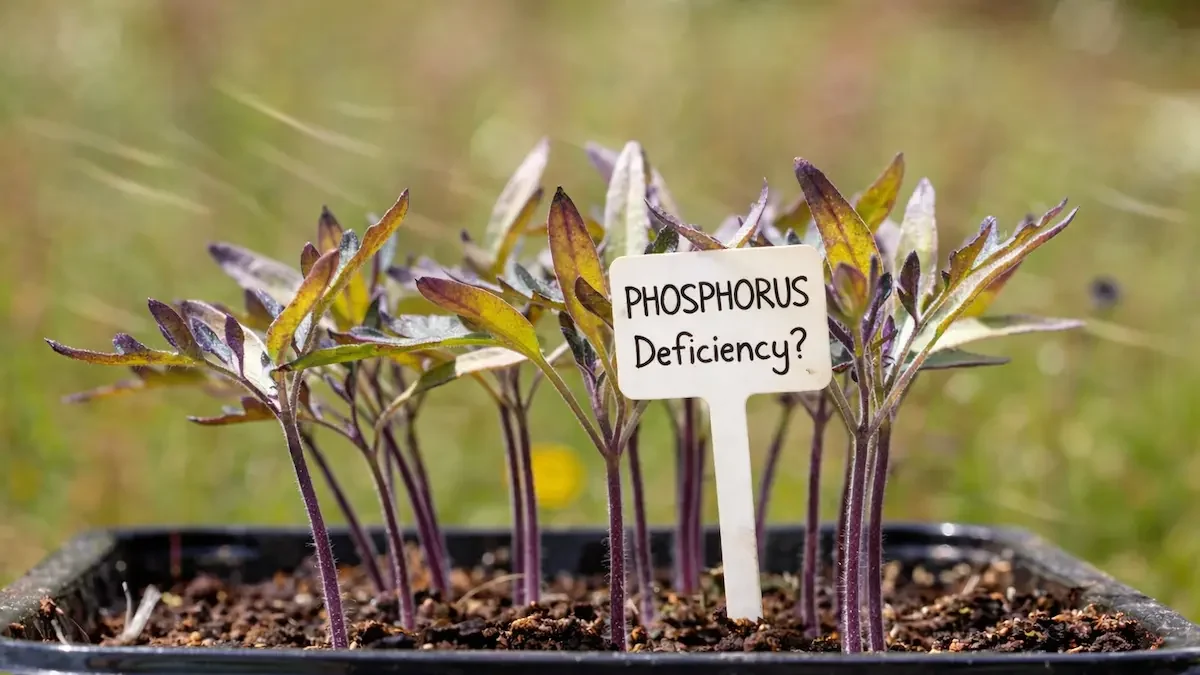
Check the undersides of your tomato seedling leaves right now. If the leaf veins or stems have shifted from green to reddish-purple, the plant is telling you something specific — and in most cases it’s fixable within a week. According to University of Maryland Extension, purple discoloration on tomato seedling stems and leaf undersides is very common in new transplants and seedlings, caused by phosphorus deficiency and stress factors. Plants recover when the underlying condition is corrected.
The short answer:
- Purple leaf undersides and veins = phosphorus deficiency triggered by cold soil below 60°F
- Purple color on seedlings sitting near cold windows = move trays to a warmer spot immediately
- Pale, stretching seedlings with purple tint = light deficiency compounding the problem
- Most cases resolve within 7–14 days once soil temperature and light are corrected
Why Phosphorus Is the Mechanism Behind Almost Every Case
Purple coloration in tomatoes comes from anthocyanin pigments — the same pigments that make red cabbage red. Tomatoes produce anthocyanins when they can’t access phosphorus, because without it the plant’s energy transfer system breaks down and sugars pool in leaf tissue instead of moving through it.
The critical detail: phosphorus deficiency in seedlings is most likely a result of cool root zone temperatures, not a shortage in the soil mix. The phosphorus is there — the roots can’t take it up. Adding fertilizer alone doesn’t fix the problem if soil temperature is below 60°F.
Cause 1: Soil Temperature Below 60°F
This is the cause in the majority of March seedling cases. A grow room at 68°F with trays on a cold windowsill or concrete floor can have soil temperatures of 52–56°F inside the cells — cold enough to block phosphorus uptake completely.
When soil temperatures drop below 55°F, phosphorus becomes less available to plants even if it’s present in the soil — a condition known as cold-induced phosphorus deficiency that is particularly common in early spring plantings.
Fix:
- Move trays off cold surfaces immediately — place them on a wooden board or folded towel to insulate from below
- Use a soil thermometer to check temperature inside the cells, not the room temperature
- A seedling heat mat raises soil temperature 10–20°F above ambient
- Target soil temperature: 65–75°F for tomatoes
Color improvement should be visible within 7–10 days once soil warms consistently above 60°F.
Cause 2: Light Deficiency Compounding the Problem
Low light doesn’t directly cause phosphorus deficiency, but it slows root development — and slow roots mean slower phosphorus uptake, which worsens the purple coloration. Seedlings stretching toward a window and showing purple tints are showing two stress signals at once.
Younger tomato plants are more sensitive to inadequate light, and low soil temperatures combined with poor light create compounding stress that intensifies purple discoloration.
Fix:
- Keep grow lights 2–4 inches above seedling tops, run 14–16 hours per day
- Window growing in March: south-facing only, supplement with a basic LED shop light
Cause 3: Overwatering Slowing Root Activity
Waterlogged soil pushes oxygen out of pore spaces around roots. Without oxygen, nutrient uptake stalls and phosphorus deficiency symptoms appear even in warm soil. The tell: soil that stays dark and wet for more than 2 days, or trays sitting in standing water.
Fix:
- Allow the top 0.5 inches to dry before watering again
- Empty drainage saucers within 30 minutes of watering
- If potting mix feels compacted, repot into a fresh mix with adequate perlite
When Purple Color Is Not a Deficiency
Two situations don’t require intervention. First, variety genetics: purple or dark-fruited types like ‘Black Krim’ naturally produce anthocyanin pigmentation in leaves — if the whole plant is evenly tinted and growing vigorously, this is likely genetic. Second, intense grow light exposure: if lights are closer than 2 inches and seedlings look compact and healthy, simply raise the fixture before doing anything else.
What Not to Do
❌ Adding heavy phosphorus fertilizer before true leaves appear — young roots can burn before the first true leaf stage. Hold fertilizer until seedlings have at least one set of true leaves, then apply at quarter-strength.
❌ Assuming the potting mix is deficient and repotting immediately — in March, cold soil temperature is the cause in most indoor cases. Repotting adds transplant stress without addressing the actual problem. Warm the soil first and give it 7 days.
❌ Moving purple seedlings outdoors to “get more light” — outdoor temperatures in March in Zones 5–6 will worsen phosphorus lockout. Cold air exposure on stressed seedlings compounds the problem rather than solving it.
This Week and Next 14 Days
This week — March 15–21:
- Check soil temperature inside seedling trays at 7 AM — confirm it’s above 60°F
- Move any trays sitting on cold surfaces or near drafty windows to a warmer position
- Assess light: if seedlings are visibly stretching, lower the grow light or add supplemental lighting
- Check drainage saucers — empty any that hold standing water
By March 29:
- If soil temperature is now consistently above 60°F and purple coloration persists, apply a diluted balanced fertilizer at quarter-strength once true leaves are present
- Reassess light levels — compact growth with deepening green color confirms the fix is working
- Any seedlings still showing purple after 14 days of correct temperature and light warrant a soil pH check — target 6.0–6.8 for tomatoes