
Water-bath canning is the simplest home canning method — no specialist equipment beyond a large pot, no pressure gauge to calibrate, and a straightforward set of rules that do not change between recipes. Understanding why pH 4.6 is the critical threshold makes every decision in the process logical rather than arbitrary.
Quick Answer
Why pH 4.6 is the critical number: Clostridium botulinum — the bacterium responsible for botulism — cannot produce its toxin at or below pH 4.6. Boiling water reaches 100°C (212°F), which is sufficient to destroy spoilage organisms in high-acid food but not enough to kill C. botulinum spores in low-acid food. Water-bath canning is safe only when the food’s acidity keeps the spores inactive.
What you can water-bath can: fruits, jams, jellies, marmalades, pickles, chutneys, fruit butters, and tomatoes with added lemon juice. All have a pH reliably below 4.6.
What you cannot water-bath can: vegetables (except pickled), meat, fish, dairy, and any recipe that mixes low-acid vegetables with insufficient acid. These must be pressure-canned or they are unsafe regardless of processing time.
According to the National Center for Home Food Preservation’s canning principles guide, the choice between water-bath and pressure canning is determined entirely by the acidity of the food. Foods with a pH at or below 4.6 are classified as high-acid and can be safely processed in a boiling water bath. Foods above pH 4.6 are low-acid and require a pressure canner to reach the temperatures — 116–121°C (240–250°F) — needed to destroy C. botulinum spores. Boiling water can never exceed 100°C regardless of how long it boils. The Cornell Cooperative Extension notes that tomatoes occupy a borderline position — some modern varieties and growing conditions can produce tomatoes at pH 4.3–4.9 — which is why NCHFP now requires adding bottled lemon juice or citric acid to all tomato recipes to guarantee safe acidity.
What Can and Cannot Be Water-Bath Canned
| Food | Typical pH | Water-Bath Safe? | Notes |
|---|---|---|---|
| Strawberries, raspberries, currants | 3.0–3.5 | Yes | Well below threshold; straightforward for jam, jelly, whole fruit |
| Apples, plums, damsons | 3.3–4.0 | Yes | Ball Blue Book (38th ed., 2024) now recommends added lemon juice for apple recipes as a safety margin |
| Tomatoes | 4.3–4.9 depending on variety | Yes — with added acid | Add 1 tbsp bottled lemon juice per pint jar (2 tbsp per quart) — NCHFP requirement; do not substitute fresh lemon juice |
| Pickled cucumbers, beetroot, onions | 3.4–4.1 after pickling | Yes | Acidity comes from vinegar; must use tested recipe with correct vinegar ratio |
| Green beans, peas, carrots | 4.6–6.0 | No — pressure can only | Cannot be made safe in a water bath; botulism risk is real and serious |
| Courgettes, squash | 5.5–6.5 | No — pressure can or pickle | Can be pickled (water-bath safe) but not canned plain |
The Process — Step by Step
Sterilise jars and lids
Wash jars in hot soapy water; rinse. Keep hot until filling — either in a low oven (110°C) or submerged in the canning pot. Use new lids each time; rings can be reused if undamaged. Never reuse commercial food jars — they are not made to withstand repeated thermal cycling.
Prepare produce and fill jars
Follow a tested recipe exactly — do not adjust ingredient ratios. Fill hot jars with hot product, leaving the headspace specified in the recipe (typically 6–12mm for jams; 12mm for whole fruit and tomatoes). Wipe jar rims clean with a damp cloth — any residue on the rim prevents a proper seal.
Process in boiling water
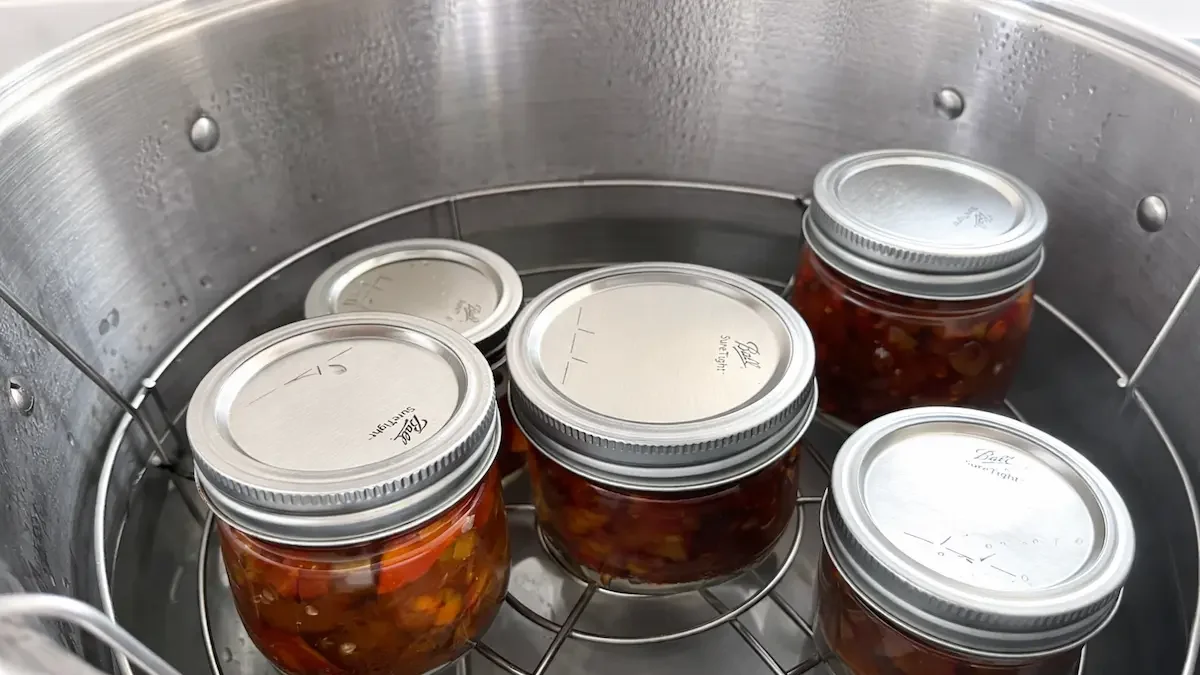
Place filled jars on a rack in a canning pot; cover with at least 2.5cm of water above jar lids. Bring to a full rolling boil before starting the timer. Process for the time specified in the recipe — timing begins when water returns to a full boil, not when you add the jars.
Remove, cool, and check seals
Lift jars out without tilting; place on a clean towel with 2.5cm gaps between jars. Leave undisturbed for 12–24 hours. Do not press lids or tighten rings while cooling. After 24 hours: press the centre of each lid — it should be concave and firm. Any lid that flexes or pops has not sealed and must be refrigerated and used within a week.
What to Do
- Use only tested recipes from NCHFP, USDA, or reputable extension sources— the processing times in tested recipes account for heat penetration, density, and pH. Untested internet recipes cannot be assumed to be safe regardless of how credible they appear
- Add bottled lemon juice to all tomato recipes— 1 tablespoon per pint jar; 2 tablespoons per quart. Use bottled lemon juice, not fresh — bottled has a standardised and consistent acid level that fresh juice does not
- Start timing when water reaches a full rolling boil— not when you lower the jars in; adding cold jars drops the water temperature and timing must not begin until it returns to a full boil
- Check every seal after 24 hours— any unsealed jar must be refrigerated immediately; the seal is the only barrier between the preserved food and spoilage
- Never water-bath can plain vegetables— green beans, peas, carrots, and courgettes cannot be made safe at 100°C regardless of processing time; pressure canning reaches the temperatures required to destroy botulism spores in low-acid foods
Common Mistakes
- Adjusting recipe ratios— adding more vegetables to a salsa recipe, reducing vinegar in a pickle, or increasing the sugar in a chutney all alter the final pH; only the tested proportions are guaranteed safe
- Using commercial food jars— pasta sauce, peanut butter, and pickle jars are made for single use and cannot reliably withstand repeated high-temperature processing; use purpose-made canning jars (Ball, Kilner, Le Parfait)
- Skipping the headspace— insufficient headspace prevents proper vacuum formation; too much headspace leaves excess air inside; follow the specific measurement in each recipe