
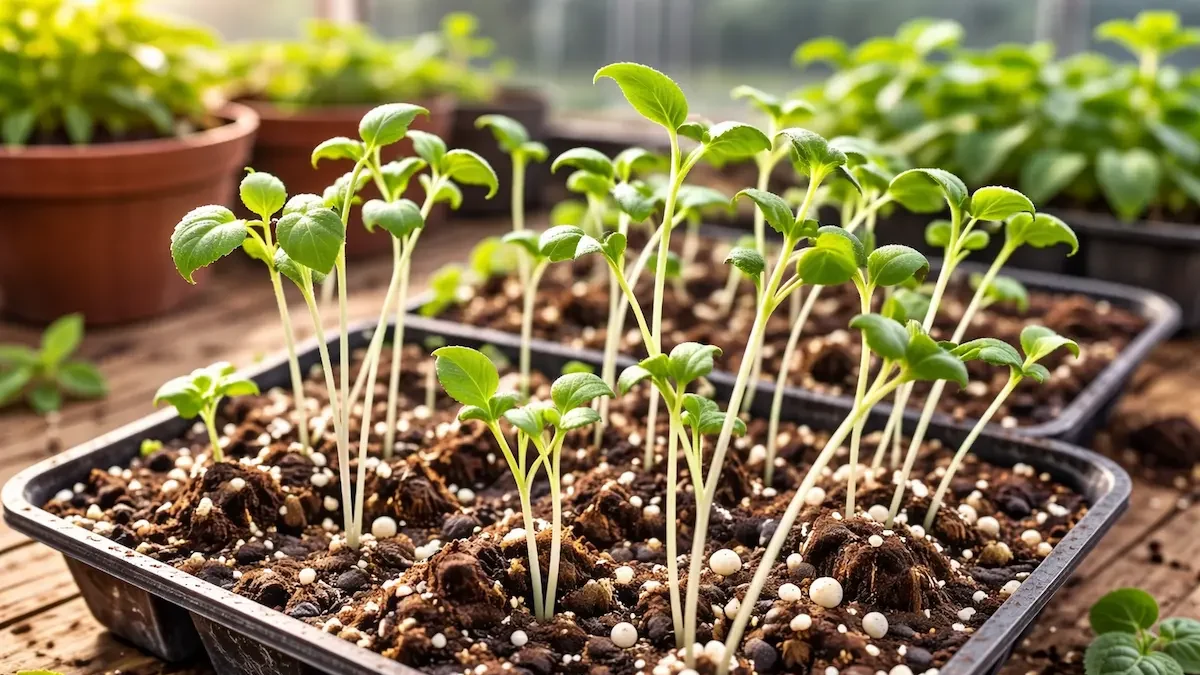
Leggy, pale, floppy seedlings are not a feeding problem or a watering problem. They are the plant’s hormone-driven response to insufficient light — a survival mechanism that has been making gardeners frustrated for as long as people have tried to grow plants on windowsills.
Quick Answer
Primary cause: insufficient light intensity. The plant produces auxin hormones that drive cell elongation in the stem — reaching for the light source. This is etiolation: a hardwired survival response, not a sign of disease.
Why heat makes it worse: research published in Nature Communications (2025) found that light and temperature interact to control stem elongation — warm temperatures amplify the elongation response. High germination temperature combined with low light is the most common cause of severely leggy seedlings.
The fix: more light, lower temperature, and move the light source closer. You cannot fix etiolated seedlings with fertiliser. You can only prevent the next batch from becoming leggy.
According to ScienceDirect’s review of etiolation research, lack of sufficient light retards chlorophyll formation and promotes slender growth with long internodes — pale leaves, spindly stems too weak to support their own weight. This is etiolation: the result of a completely normal hormone response. When a plant detects insufficient red light, phytochrome B receptors remain inactive, releasing phytochrome-interacting factors that activate genes for rapid stem elongation. The plant is not malfunctioning. It is doing exactly what evolution shaped it to do: growing fast toward a light source, at the expense of structural strength.
Why Light Intensity Matters More Than Duration
The most common misunderstanding is that the solution is more hours of light. Duration matters, but intensity matters more. A south-facing windowsill provides perhaps 10–20% of outdoor direct sun — glass filters much of the photosynthetically active radiation, and winter light is already low. A seedling 30cm from the glass receives substantially less usable light than one pressed against the pane, and far less than one under a grow light at 5–10cm.
Research in Nature Communications identified a photothermal molecular switch: temperature governs whether light represses or activates stem elongation. At cool temperatures, adequate light strongly suppresses elongation. At warm temperatures, the same light suppresses elongation less effectively. Seedlings kept warm for germination — on a heat mat, near a radiator — and left warm under low light will stretch dramatically faster than cool seedlings in the same conditions. Once seeds germinate: remove heat and lower temperature to 15–18°C while improving light supply.
All Four Causes — and Their Fixes
| Cause | What You See | Fix |
|---|---|---|
| Insufficient light intensity | Long, pale stems; small leaves; seedlings lean toward window | Move light source closer (5–10cm above seedlings for grow lights). Rotate trays daily if using a window. Reflective surfaces behind trays increase light from all angles |
| Too warm after germination | Fast, floppy growth; very pale colour; leaves underdeveloped | Remove from heat mat immediately after germination. Move to cooler room (15–18°C). Cool temperatures slow elongation and produce stockier plants |
| Sown too early | Seedlings are leggy before outdoor conditions are suitable for hardening off | Check days-to-transplant on seed packet. Most crops need only 4–8 weeks indoors. Sowing 12 weeks early means 4–8 extra weeks of low-light stress |
| Overcrowded tray | Seedlings shade each other; central plants stretch more than edge ones | Thin promptly to recommended spacing. Crowded seedlings compete for light and trigger shade-avoidance elongation in each other |
Can You Fix Already-Leggy Seedlings?
Partially. Once a stem has elongated, it does not compact again — but new growth will be sturdier if light improves immediately. Tomatoes and courgettes can be planted deeper at transplant time, with the leggy stem buried up to the lowest leaves; buried stem produces adventitious roots and turns weakness into a root system advantage. Brassicas, lettuce, and root crops buried too deep will rot rather than root. For these, the leggy seedling is effectively a loss; prevention matters more than remediation.
Prevention — the Only Effective Strategy
- Position grow lights 5–10cm above seedling trays— raise as plants grow. Most leggy seedlings under grow lights result from lights set too high
- Remove heat mat immediately after germination— heat drives elongation once seedlings are above soil. Grow on at 15–18°C for compact, sturdy plants
- Sow at the right time— count back from your last frost date using the seed packet’s indoor start recommendation. Sowing too early means weeks of low-light stress with nowhere to go
- Brush seedlings lightly once daily— physical contact triggers thigmomorphogenesis, producing shorter, thicker stems. 30 seconds per tray, gently
- Use a fan on low— gentle air movement mimics outdoor conditions and strengthens stems through mechanical stimulation
What Doesn’t Fix Leggy Seedlings
- Adding fertiliser— legginess is a structural problem from cell elongation, not nutrient deficiency. Feeding will not shorten or strengthen an already-stretched stem
- Moving to a slightly brighter windowsill— the difference between a north and south window may not be enough. A substantial increase in light intensity is needed, not a marginal one
- Watering more— overwatering compounds legginess by creating damping-off conditions in weakened stems
Right Now
- Move trays as close to light source as possible
- Remove heat mat from germinated seedlings
- Set a fan on low near seedling area
- Brush seedling tops gently once daily
Next Sowing
- Count back from last frost date — don’t sow too early
- Keep grow lights 5–10cm above trays; raise as plants grow
- Germinate warm; grow on cool (15–18°C)
- Thin promptly — crowding triggers shade-avoidance response