
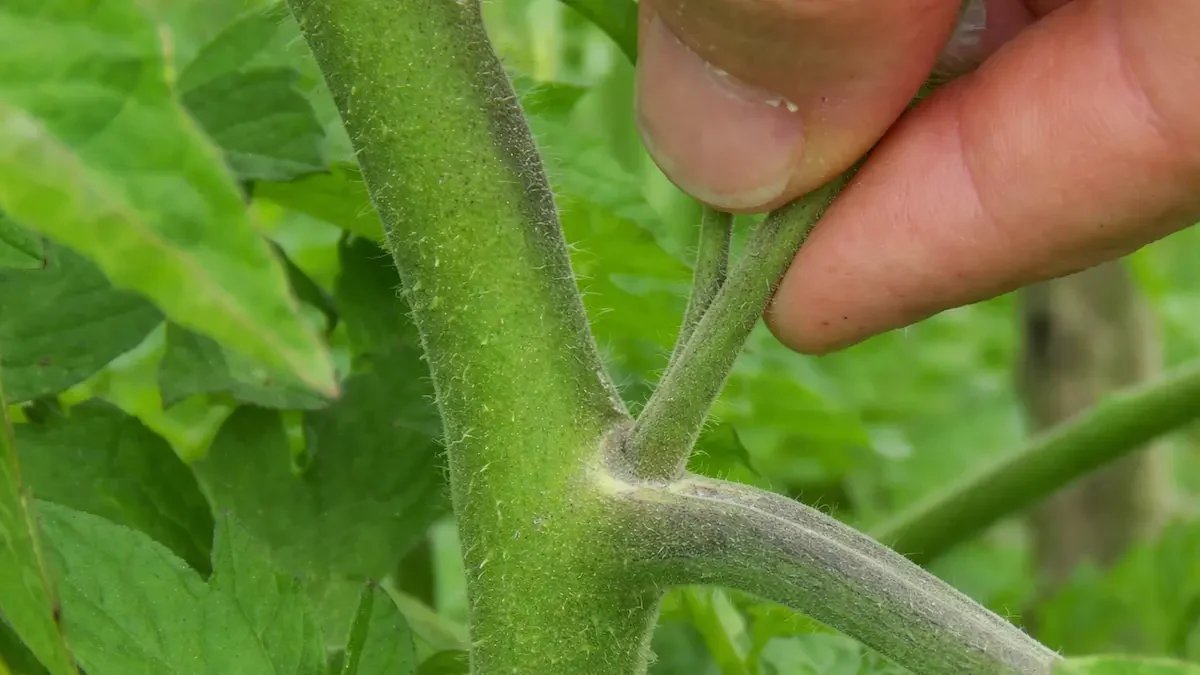
Pinching out tomato side shoots — often called “suckers” — is one of the simplest tasks in the garden, yet it has a major impact on how your plants grow and how much fruit they produce. Done correctly, it directs the plant’s energy into fruit rather than excess foliage. Done incorrectly — or ignored entirely — it can lead to dense, unproductive plants with smaller yields.
The key is understanding when it matters and when it doesn’t.
What Side Shoots Actually Are
Side shoots grow in the joint between the main stem and a leaf branch. At first, they look like small new stems, but if left alone, they develop into full secondary stems with leaves, flowers, and eventually fruit.
This sounds beneficial — more stems, more fruit — but in practice, it spreads the plant’s energy too thin.
According to Royal Horticultural Society tomato pruning guide, removing side shoots helps maintain strong growth and improves fruit size and ripening.
The Critical Rule: Not All Tomatoes Need Pinching
This is where most beginners go wrong.
Only indeterminate (cordon) tomatoes need side shoots removed. These are tall, continuously growing varieties trained on a single stem.
Determinate (bush) tomatoes do not need pinching. Removing shoots on these reduces yield because they are naturally designed to grow multiple stems.
If you’re unsure:
- Tall, climbing tomatoes → pinch
- Compact, bushy tomatoes → leave alone
Getting this wrong is one of the fastest ways to reduce production.
When to Start Pinching
Start as soon as side shoots are visible — usually when plants are about 20–30 cm tall and growing strongly.
At this stage:
- Shoots are small and easy to remove
- The plant recovers quickly
- Growth stays controlled from the beginning
If you wait too long, side shoots become thick stems, and removing them creates larger wounds that stress the plant.
How to Remove Side Shoots Properly
The simplest method is also the best.
Use your fingers to pinch the shoot off when it is small — ideally under 5–7 cm long. Bend it gently to one side, and it will snap cleanly.
This avoids the need for tools and reduces the risk of disease.
For larger shoots, use clean scissors or pruners to make a clean cut. Avoid tearing, as this damages the plant.
Why It Makes Such a Difference
When you remove side shoots, you are simplifying the plant’s structure.
Instead of multiple competing stems, the plant focuses on:
- Strong vertical growth
- Larger fruit development
- Better airflow and light penetration
This results in:
- Bigger tomatoes
- Earlier ripening
- Lower risk of disease
Without pruning, plants often become dense and tangled, making management difficult and reducing overall quality.
Frequency: A Small, Regular Task
Pinching is not a one-time job. Tomatoes grow quickly, especially in warm conditions.
Check plants every few days during peak growth. Side shoots can appear and grow rapidly, and removing them early is always easier.
This takes only a few minutes but prevents much larger problems later.
What Happens If You Don’t Pinch
If side shoots are left:
- Plants become overcrowded
- Energy is divided across too many stems
- Fruits are smaller and slower to ripen
- Airflow is reduced, increasing disease risk
In some cases, plants can become so dense that harvesting becomes difficult.
That said, unpruned plants will still produce — just less efficiently.
A Balanced Approach
Some growers intentionally leave one or two extra stems to increase yield slightly. This can work in very fertile conditions, but it requires more space and support.
For most small-scale growers, a single-stem system is the most reliable and manageable approach.
Late Season Adjustment
Toward the end of the season, it’s often useful to stop new growth entirely.
This is done by pinching out the growing tip of the main stem. It signals the plant to stop producing new flowers and focus on ripening existing fruit.
This is especially important in cooler climates where late fruit won’t have time to mature.
Common Mistakes
The biggest mistake is pinching bush varieties. This reduces yield significantly.
Another common issue is letting shoots grow too large before removing them. This wastes energy and stresses the plant.
Inconsistent pruning is also a problem. Skipping checks for a couple of weeks can result in a plant that’s difficult to correct.
Finally, over-pruning can weaken the plant. The goal is control, not stripping it down completely.
A More Practical Way to Think About It
Pinching is not about removing growth — it’s about directing it.
You are deciding where the plant invests its energy. Instead of growing everywhere, it grows where it matters.
Once you see it that way, the process becomes much more intuitive.
Long-Term Results
Well-managed tomato plants are easier to care for, easier to harvest, and more productive per plant. The difference becomes obvious by mid-season.
Instead of a tangled mass of leaves, you get a structured plant with clearly visible fruit trusses and steady ripening.
That consistency is what makes pinching worthwhile. It’s a small habit that leads to significantly better results over the entire season.