
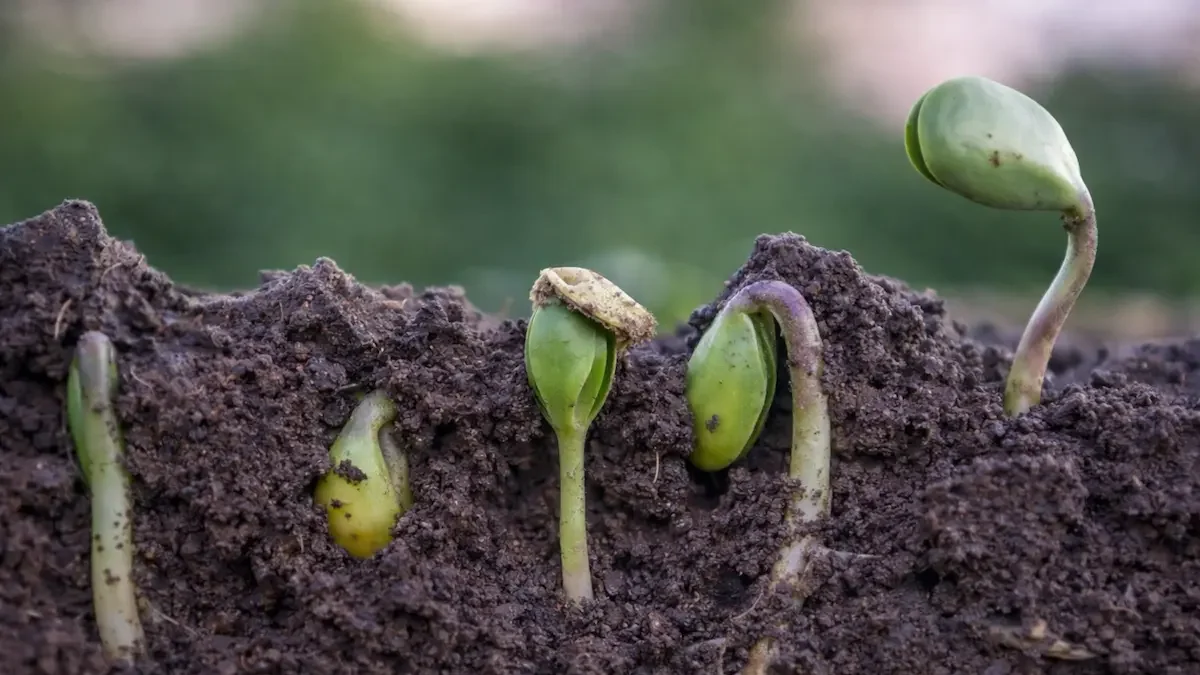
A patchy row of seedlings is almost never a seed quality problem. It is almost always a soil moisture problem — specifically, uneven moisture at seed depth. Here’s what causes it, why it matters more than most
Quick Answer
The main cause: uneven soil moisture at seed depth — some seeds sit in adequately moist soil, others in soil that is too dry, too wet, or lacking direct contact with moist particles.
The fix before sowing: water the bed thoroughly the day before, let it drain, then sow into moist — not wet — soil. Firm the soil over every seed to ensure direct contact. Cover with fleece or a board to retain moisture until germination begins.
The fix after a dry spell: gentle overhead watering twice daily until seedlings emerge — but only if the bed was properly prepared first. Watering over dry-crusted soil doesn’t reach the seed zone.
According to Purdue University Extension’s germination research, uneven soil moisture at seed depth is the most frequent cause of uneven emergence — with yield losses of 8 to 10 percent in field crops. In a home vegetable garden, the consequence is more personal: patchy rows, gaps you try to fill with extra seeds, and half a row inert while the other half is already growing. The cause is almost never the seeds. It is the environment around them.
What Seeds Actually Need — and Why Uniformity Matters
Germination begins with imbibition: the seed absorbs water from surrounding soil until it triggers metabolic processes. ECHOcommunity’s germination guide explains the requirement: moist soil must be in firm direct contact with the seed. Without that contact, nearby moisture cannot move efficiently into the seed. A seed against a clod imbibes slowly — while a neighbour in firm contact with moist particles germinates normally. Firming matters as much as moisture itself.
The Six Causes of Uneven Germination
| Cause | What Happens | Fix |
|---|---|---|
| Variable sowing depth | Shallow seeds dry out faster; deep seeds germinate later. Creates an uneven row. | Use a dibber to maintain consistent depth. Most vegetable seeds: ½–1 inch. |
| Poor seed-to-soil contact | Seeds resting against clods or in loose furrows absorb moisture slowly or not at all. | Firm soil over each row with the back of a rake. Press, don’t compact. |
| Surface drying between watering | Warm, windy days dry the top inch quickly. Shallow-sown seeds are most vulnerable. | Cover the sown bed with fleece or a board until emergence. Water gently at soil level. |
| Soil crust formation | Heavy rain on bare soil creates a surface crust. Emerging seedlings die just below the surface. | Break the crust gently with a finger as soon as it forms. Mulching prevents it. |
| Clay soil waterlogging | Saturated clay displaces oxygen from the seed zone. Seeds need oxygen — waterlogged seeds rot. | Add compost before sowing. Never sow into saturated beds. |
| Sandy soil rapid drainage | Sandy soil dries faster than seeds can absorb enough moisture, especially in spring wind. | Add compost to improve water retention; water the evening before sowing; cover after sowing. |
The Step Most Gardeners Skip
Firming the soil after sowing is the most underrated step in germination. Purdue Extension notes that good seed-to-soil contact is vital for uniform imbibition. In loose, unworked soil without firming, moisture reaches each seed at different rates. The result is the patchy emergence gardeners blame on old seeds. A firm, fine seedbed — no clods, then pressed over the sown row — eliminates this variable entirely.
✓ Sowing for Uniform Germination
- Prepare a fine, clod-free seedbed— rake until the top 2 inches is crumbly and uniform. Clods create air pockets that prevent seeds from absorbing moisture.
- Water the bed the evening before sowing, not the day of— sowing into wet soil causes compaction and poor furrow closure. Moist, well-drained soil is the target.
- Sow at consistent depth— use a marked stick or dibber. Fine seeds (carrots, lettuce): ¼–½ inch. Medium (beetroot, chard): ½–1 inch. Large (peas, beans): 1–2 inches.
- Firm soil over every row immediately after sowing— ensures seed-to-soil contact and seals the furrow against rapid surface drying.
- Cover with fleece or a plank until germination— traps moisture and prevents surface crust. Remove as soon as the first seedlings appear.
✗ What Makes Germination Worse
- Sowing into dry soil and relying on watering to compensate— overhead watering on a dry seedbed wets the surface but rarely penetrates to seed depth uniformly, especially in sandy or compacted soil
- Leaving the bed bare in windy weather— the top inch can dry completely in an afternoon of warm wind, even after morning watering
- Re-sowing gaps before 3 weeks— the soil at seed depth may still be adequate; gaps are often slow seeds, not failed ones
📅 Before Sowing
- Rake seedbed to fine, clod-free tilth
- Water bed thoroughly the evening before
- Check moisture by feel at 1 inch depth — damp, not wet
- Prepare fleece or boards to cover after sowing
📆 After Sowing
- Firm soil over every row immediately
- Cover with fleece; check daily for emergence
- Water at soil level if surface dries — not overhead
- Wait 3+ weeks before judging germination as failed