
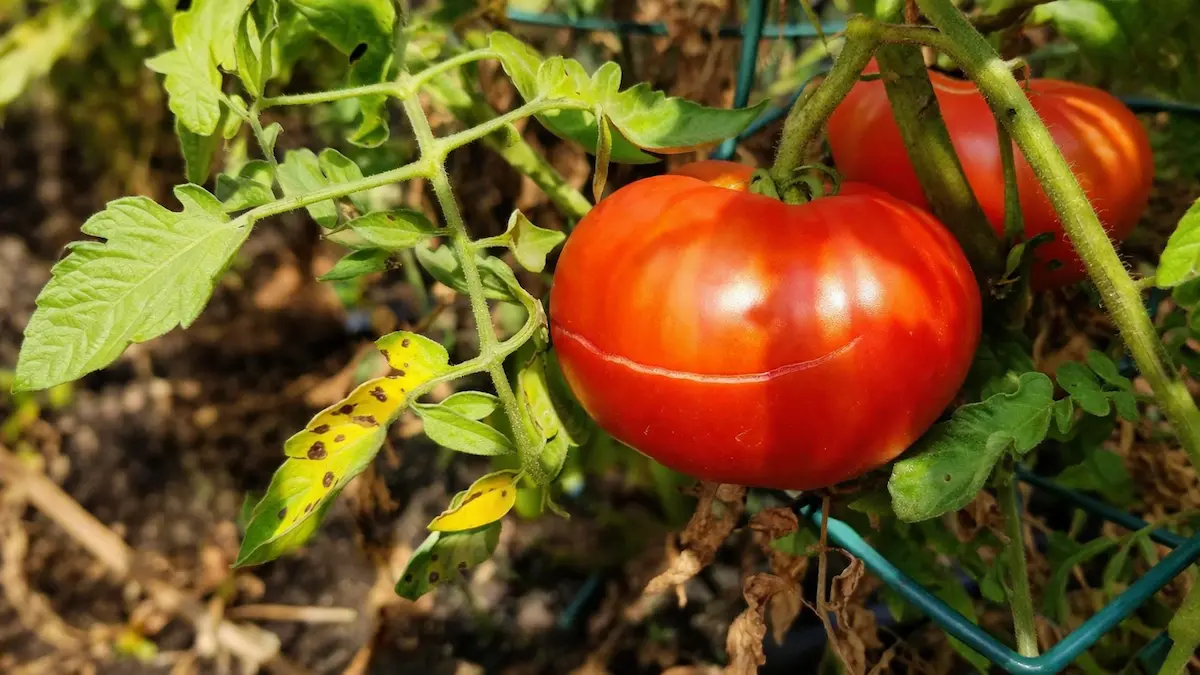
Tomato splitting is not a disease and it is not a sign that something has gone fundamentally wrong. It is a physiological response to rapid water uptake — the fruit expands faster than its skin can stretch. One type is preventable. The other is genetic and cosmetic. Knowing which you are dealing with changes what to do about it.
Quick Answer
Radial cracking (vertical splits running from stem to blossom end) is caused by inconsistent moisture — typically a dry spell followed by heavy rain or sudden heavy watering. It is preventable with mulch, consistent irrigation, and timely harvesting.
Concentric cracking (rings around the stem end) is primarily genetic — certain varieties produce it regardless of watering practice. It is cosmetic and does not affect flavour. The only solution is variety selection.
Split tomatoes are safe to eat if harvested immediately and used within 24–48 hours. Once the skin is open, bacteria and fungi enter rapidly. Do not store split fruit alongside intact tomatoes — ethylene from the split fruit accelerates ripening and decay in the rest.
According to NC State Cooperative Extension, heavy rain — especially when preceded by dry weather — is the leading cause of fruit cracking and splitting in tomatoes. Cracking and splitting occur when rapid changes in soil moisture cause fruits to expand faster than the skin can grow. The damage is most likely as tomatoes begin to ripen, when the skin is already at near-maximum stretch, though green fruit can split too. Iowa State University Extension adds that the problem is compounded by hot, humid conditions — both temperature fluctuations and excess humidity encourage rapid internal water movement that the skin cannot accommodate.
Two Types of Cracking — and What Each Means
| Type | What It Looks Like | Cause | Can You Prevent It? |
|---|---|---|---|
| Radial cracking | Vertical splits running from stem toward blossom end; can be deep and expose flesh | Inconsistent moisture; rapid water uptake after dry period; hot humid weather | Yes — with mulch, even watering, timely harvest |
| Concentric cracking | Rings or shallow cracks around the stem end; usually surface-level only | Primarily genetic — certain varieties are predisposed regardless of care | Only by variety selection; cannot be watered or fed away |
The Mechanism — Why Consistent Watering Matters
Tomato skin is composed of cellulose, pectin, and a waxy polymer called cutin that regulates water loss. Its elasticity is highest during early fruit development and declines as the fruit ripens and the skin stretches toward its limit. When a ripe or near-ripe tomato suddenly receives a large influx of water — through rain, irrigation, or even high humidity — the flesh expands faster than the skin can accommodate and the skin splits. The internal pressure is highest at the stem end, which is why both types of cracking concentrate there. Maintaining consistent soil moisture prevents the feast-or-famine cycle that creates that sudden pressure spike.
What to Do
- Mulch deeply around all tomato plants— a 5–8cm layer of straw or wood chip maintains even soil moisture through rain events and dry spells, buffering the sudden moisture swings that cause radial cracking
- Water consistently and at the base— drip irrigation or a soaker hose at the root zone is far more effective than irregular overhead watering; aim to keep soil consistently moist rather than alternating wet and dry
- Harvest at first blush, not at full colour— NC State Extension notes that splitting is most likely just before harvest; picking tomatoes at the breaker stage (when colour change begins) and ripening indoors eliminates the highest-risk window
- Remove foliage carefully after wet spells— excess foliage traps humidity around ripening fruit; good airflow reduces the ambient humidity that contributes to surface cracking after rain
- Choose crack-resistant varieties for problem sites— Roma, Mountain Spring, Arkansas Traveler, and Floradade all have documented crack resistance; heirloom varieties with thin skins (German Johnson, Brandywine) are most vulnerable
Common Mistakes
- Waiting for full red colour before harvesting— the highest-risk moment for splitting is the final days of ripening on the vine; picking at first blush and ripening on the windowsill prevents most losses
- Adding calcium supplements for splitting— calcium deficiency causes blossom end rot, not cracking; adding calcium without a soil test will not reduce splitting and may disrupt other nutrient availability
- Storing split tomatoes with intact ones— the open wound emits ethylene and pathogens that accelerate decay in adjacent fruit; use split tomatoes immediately or discard them
After Heavy Rain
- Check all near-ripe fruit immediately
- Harvest any showing signs of cracking
- Use or process split fruit within 24 hours
- Do not store split fruit with intact tomatoes
Prevent It Next Time
- Mulch 5–8cm deep around all plants
- Switch to drip or soaker hose irrigation
- Harvest at breaker stage — first colour change
- Try crack-resistant varieties on problem-prone sites